
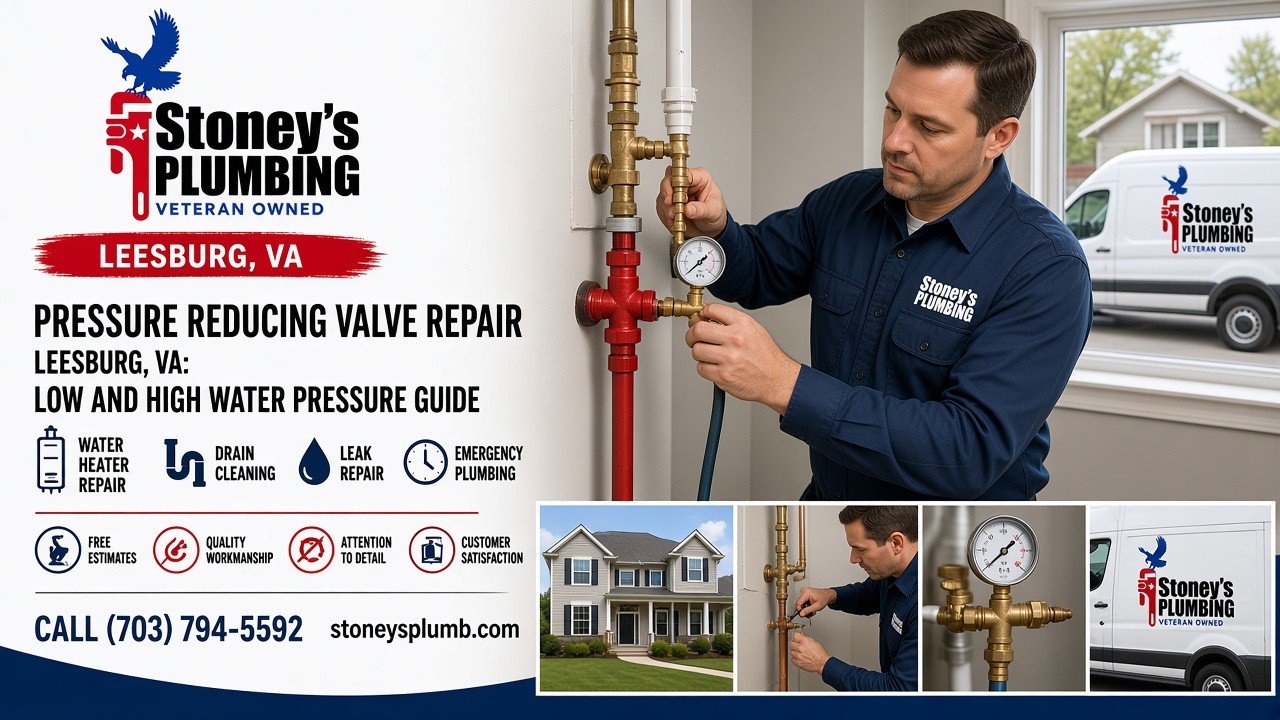
Stoney’s Plumbing · Water Pressure Guide
Water pressure is easy to ignore until it goes wrong. Showers that suddenly feel weak, faucets that bang when they shut, a toilet fill valve that hisses all night or a relief valve dripping on the water heater can all trace back to one small brass part near your main shutoff: the pressure reducing valve, often called a PRV. Pressure reducing valve repair in Leesburg is one of the most practical plumbing fixes a homeowner can make, because the right pressure protects every pipe, fixture and appliance in the house. This guide explains how a PRV works, what normal pressure looks like, the signs of high and low water pressure, how to test with a simple gauge, why valves fail, how thermal expansion and expansion tanks fit in, adjustment, repair or replacement, educational cost ranges, code basics and when to call a plumber. Stoney’s Plumbing is a veteran-owned residential plumber at 574 Rockbridge Dr SE, Leesburg, VA 20175, and we answer calls 24/7.
How do you know your pressure reducing valve needs repair in Leesburg, VA, and what does it cost?
A pressure reducing valve in a Leesburg home usually needs attention when a gauge on a hose bib reads above 80 psi, when pressure creeps higher overnight, when pressure suddenly drops throughout the house, or when you notice banging pipes, running toilets, a dripping water heater relief valve or a humming valve near the main shutoff. Most homes do best between about 50 and 70 psi. As educational ranges, a pressure test and adjustment often runs about $100 to $250, a PRV rebuild about $200 to $400, a full PRV replacement about $350 to $900, and a thermal expansion tank about $250 to $600 installed. These are general planning figures, not quotes.
A failing PRV rarely fixes itself. High pressure keeps stressing hoses, valves and seals every hour of the day, and low pressure from a stuck valve only gets more frustrating.
Local context: Many Leesburg, Ashburn and Lansdowne homes sit on water mains that deliver more than 80 psi at the street, which is why builders installed PRVs in so many Loudoun County houses from the 1980s onward. Those valves typically last about 10 to 15 years, so a large share of local homes now have original valves near the end of their service life. Call Stoney’s Plumbing at (703) 794-5592 or find Stoney’s Plumbing on Google Maps.
How a Pressure Reducing Valve Works
Quick answer: A PRV is a spring-loaded valve installed on the main water line just after the main shutoff. A spring pushes against a diaphragm, and the diaphragm moves a seat that opens or narrows the water path so the pressure leaving the valve stays near a set point, no matter how high the pressure coming in from the street is.
Public water systems keep mains at high pressure so water can reach hilltops, fire hydrants and tall buildings. That pressure is useful for the utility but too much for the inside of a house. The pressure reducing valve is the gatekeeper between the two. On the inlet side, it sees whatever the street delivers, which in parts of Loudoun County can be 90, 100 or even 120 psi. On the outlet side, it delivers a steady, lower pressure to the home.
Inside the bell-shaped brass housing are a few simple parts. An adjustable spring sits on top, held by a screw with a lock nut. Below it is a rubber diaphragm. Below that is a valve stem and a seat with a rubber disc. When you open a faucet, pressure downstream drops a little, the spring pushes the diaphragm down, and the valve opens wider. When you close the faucet, downstream pressure rises, pushes the diaphragm back up against the spring, and the valve closes down. That constant balancing happens every time someone runs water.
Most residential PRVs also include a fine strainer screen at the inlet to catch sand, scale and debris. Some have a built-in bypass that lets expanding hot water push back toward the street, but many modern installations do not, which is why thermal expansion matters in a later section.
Because the parts are mostly rubber and springs, a PRV is a wear item. The diaphragm hardens, the seat wears, the strainer clogs and the spring fatigues. A PRV that worked perfectly for a decade can drift slowly over several years before anyone notices.
Where the PRV fits in the water system
Water comes from the street main, through the meter, through the buried service line, through the foundation wall or slab, then reaches the main shutoff valve. The PRV usually sits a few inches to a foot after that shutoff. Many homes also have a second valve after the PRV, a thermal expansion tank on the cold line near the water heater, and a temperature and pressure relief valve on the water heater itself. All of these parts work as a team. For more on the buried pipe that feeds all of it, see our guide to main water service line repair and warning signs.
What Normal Water Pressure Looks Like
Quick answer: Most homes are comfortable and safe between about 50 and 70 psi with water off. The plumbing code generally caps static pressure inside a home at 80 psi, and pressure under about 40 psi usually feels weak, especially upstairs or with two fixtures running.
Water pressure is measured in pounds per square inch, or psi. Static pressure is the reading with everything off. Working or flow pressure is what you see with water running, and it always reads lower because flowing water loses pressure to friction in the pipes, valves and fittings.
A good target for most single-family homes in Leesburg is about 55 to 65 psi static. At that range, showers feel strong, appliances fill normally, and hoses, supply lines and valves are not under constant strain. Homes with tall stairwells or third-floor bathrooms sometimes sit closer to 65 or 70 psi to compensate for the height, since every foot of rise costs about 0.43 psi.
| Static pressure | What it usually means |
|---|---|
| Under 40 psi | Weak flow, poor shower performance, slow appliance fills. Look for a stuck PRV, clogged strainer, partially closed valve or supply issue. |
| 40 to 50 psi | Usable but soft, especially upstairs. Often adjustable upward if the PRV is healthy. |
| 50 to 70 psi | The comfortable, safe range for most homes. |
| 70 to 80 psi | Strong but harder on fixtures. Worth watching, and often worth turning down. |
| Over 80 psi | Above the usual code limit for inside the home. Increases leaks, noise and appliance wear. Usually means the PRV needs adjustment, a rebuild or replacement. |
Pressure is not the same as flow. A home can have perfectly normal pressure on a gauge and still have a weak shower because of a clogged aerator, a mineral-choked showerhead or a failing cartridge. Our guide to why Leesburg homes lose water pressure covers those fixture-level causes in detail.
Signs of High Water Pressure
Quick answer: Common signs of high pressure are banging or knocking pipes when valves close, toilets that run or refill on their own, faucets that spit or spray hard, a water heater relief valve that drips, frequent supply hose and fill valve failures, and a gauge reading over 80 psi.
High pressure is the more dangerous of the two problems because it often feels pleasant. A blasting shower can seem like a good thing. Meanwhile, the extra force is wearing out every seal in the house.
- Water hammer. A loud bang or knock when the washing machine, dishwasher, ice maker or a single-handle faucet shuts off. Higher pressure means more energy in the moving water, so the shock is bigger when it stops.
- Running toilets. Fill valves are designed for normal pressure. At high pressure, they wear out faster, seep, or let the tank refill briefly every so often with nobody using it.
- Dripping faucets and spitting aerators. Cartridges and washers fail early, and water splashes out of the sink basin.
- Relief valve discharge. The temperature and pressure relief valve on the water heater, or the small discharge pipe beside it, drips or leaves a wet spot on the floor.
- Short-lived appliances and hoses. Washing machine hoses bulge, ice maker lines split, dishwasher inlet valves fail and refrigerator filters leak.
- Pressure that rises at night. When demand drops across the neighborhood, street pressure can climb. A worn PRV may pass some of that increase into the house.
Several of these at once, especially in a home more than ten years old, is a strong sign the PRV is no longer holding pressure. A gauge test confirms it in a few steps.
Signs of Low Water Pressure
Quick answer: A failing PRV can also cause low pressure. Signs include weak flow at every fixture at once, pressure that drops sharply when two fixtures run, a sudden whole-house drop with no known cause, and a gauge reading well under 45 psi when the street supply is normal.
PRVs fail in both directions. When the strainer clogs with sediment, or the seat or diaphragm sticks partly closed, the valve chokes the water supply. The result is weak flow everywhere at the same time, not just one shower or one sink.
The key clue is whether the problem is whole-house or local. If only the kitchen faucet is weak, look at its aerator or supply valve. If only hot water is weak, look at the water heater or its valves. If every fixture, hot and cold, upstairs and down, lost pressure together, the main shutoff, the PRV or the service line is the likely cause.
Another clue is sudden change. PRV strainers can clog quickly after the utility flushes hydrants or works on a main, because loosened sediment travels into homes. If pressure dropped right after you noticed work crews or discolored water, a clogged PRV screen is a common explanation.
Low pressure that develops slowly over years, combined with rusty water, can point instead to old galvanized pipe narrowing on the inside. A pressure gauge reading at the hose bib nearest the PRV, compared with a reading upstream when possible, helps tell those apart.
How to Test Your Water Pressure
Quick answer: Buy an inexpensive pressure gauge with a hose thread, screw it onto an outdoor hose bib or the laundry tub faucet, make sure no water is running in the house, open the tap fully and read the static pressure. Check it in the morning and again late at night to catch overnight creep.
A water pressure gauge costs about $10 to $25 at hardware stores. Look for one with a red lazy hand, sometimes called a max needle, which stays at the highest reading the gauge sees. That feature catches spikes you would otherwise miss.
- Pick a tap close to the PRV. An outdoor hose bib on the same side of the house, a laundry sink, or the boiler drain on the water heater all work.
- Turn off every fixture and appliance. Make sure the washer, dishwasher, irrigation and ice maker are idle.
- Thread the gauge on hand-tight and open the tap fully.
- Read the static pressure. Write it down with the time.
- Open a nearby faucet and watch the gauge drop. A modest drop is normal. A plunge to near zero suggests a restricted PRV or strainer.
- Close the faucet and watch the gauge return. It should settle back to about the same number.
- Leave the gauge on overnight with the max needle set. If the red hand is far above the morning reading, pressure is spiking or creeping.
A reading that starts at 65 and climbs to 100 overnight with no water used is classic behavior of either a PRV that is leaking through or a closed system with no room for thermal expansion. A plumber can tell which by watching the gauge while the water heater is idle compared with when it is heating.
The EPA WaterSense Fix a Leak Week resources offer simple household leak checks that pair well with a pressure test, since high pressure and hidden leaks often show up together.
Why Pressure Reducing Valves Fail
Quick answer: PRVs wear out with age, usually after about 10 to 15 years. Hard water scale, sediment in the strainer, a stiff or torn diaphragm, a worn seat and a fatigued spring are the most common failures. High street pressure and frequent pressure swings shorten the valve’s life.
Loudoun County water is moderately hard. Over years, calcium and magnesium deposits build on the moving parts of the valve. Scale on the stem makes the valve sticky, so it responds late or not at all. Scale on the seat keeps the disc from sealing, so high street pressure leaks through when the house is not using water.
The rubber diaphragm and disc also age. Chlorine and chloramine, used to disinfect public water, slowly harden many rubber compounds. A hard diaphragm cracks or loses flexibility, and the valve drifts away from its set point.
Sediment is the other big factor. Sand, pipe scale and debris from main work collect on the inlet strainer. A partly clogged strainer reduces flow. A fully clogged one can make water pressure crash. For homes that also deal with mineral buildup on fixtures, our Loudoun County hard water and softener guide explains how scale affects valves and appliances.
Typical PRV failure patterns
| Failure | What you notice |
|---|---|
| Worn seat or disc | Pressure creeps up when water is off, often overnight |
| Torn or stiff diaphragm | Erratic pressure, water leaking from the bonnet or vent |
| Clogged strainer | Weak whole-house flow, big pressure drop with fixtures open |
| Fatigued spring | Pressure slowly drifts away from where it was set |
| Corroded body or unions | Drips or green crust at the valve connections |
Thermal Expansion and Why Pressure Spikes
Quick answer: Water expands as it heats. In a home with a PRV or backflow preventer that blocks water from flowing back to the street, that extra volume has nowhere to go, so pressure inside the pipes spikes every time the water heater runs. A thermal expansion tank gives it room.
A 50-gallon tank of water heated from about 50°F to 120°F grows by roughly half a gallon to two-thirds of a gallon. That does not sound like much, but water barely compresses. In a closed system, that extra volume can push household pressure from 60 psi to well over 100 psi within one heating cycle.
Older homes without a PRV were open systems. Expanding water simply pushed back into the street main. Once a PRV, check valve or backflow device is installed, the system becomes closed. That is good for keeping street pressure out, but it means thermal expansion needs to be managed inside the house.
Signs of uncontrolled thermal expansion include a water heater relief valve that drips mainly after hot water use, a pressure gauge that jumps while the water heater burner or elements run, and toilets that hiss briefly after a shower or load of laundry.
Thermal expansion and a leaking PRV can look similar on a gauge. The difference is timing. Expansion spikes follow heating cycles. A leaking PRV causes pressure to climb toward street pressure whenever demand is low, regardless of the water heater.
Expansion Tanks
Quick answer: A thermal expansion tank is a small steel tank with an air bladder, installed on the cold water line near the water heater. As heated water expands, it pushes into the tank and compresses the air, keeping house pressure steady. Tanks typically last about 5 to 10 years.
Most expansion tanks look like a small propane cylinder, often painted white or blue, about the size of a basketball. Inside, a rubber bladder separates water from a pocket of pressurized air. The air charge should match the household’s static water pressure. If the house is set to 60 psi, the tank should be precharged to about 60 psi before it is installed.
Tanks fail in two ways. The bladder can rupture, so the tank fills completely with water and stops absorbing anything. Or the air charge can leak down slowly. You can check a tank by tapping it. The top half should sound hollow. A tank that sounds full of water from top to bottom, or one that sprays water from the air valve when the valve core is pressed, has failed.
When a PRV is replaced or reset, the expansion tank charge should be checked too. A tank charged to 40 psi in a home now set to 65 psi will not work correctly. Expansion tanks are also covered in our Leesburg water heater replacement walkthrough, because many replacements add or replace one.
Banging, Humming and Other Pressure Noises
Quick answer: Banging when valves close usually means water hammer, made worse by high pressure. Humming, whistling or chattering near the main shutoff often comes from a worn PRV vibrating. Hissing in toilets or a ticking water heater can point to pressure creeping up.
Noise is often the first clue homeowners notice. A few common sounds and what they usually mean:
- Single loud bang when a valve shuts. Water hammer. Fast-closing valves in washers, dishwashers and ice makers stop water abruptly. Lower pressure and water hammer arrestors help.
- Rattling pipes when water runs. Loose pipe straps let pipes move. High pressure makes them move more.
- A steady hum or buzz from the basement. A PRV with a worn seat or loose internal parts can vibrate, especially at low flow. The sound may travel through the house.
- Whistling at the valve. A narrow, worn opening in the PRV or a partly closed shutoff can whistle as water rushes through.
- Hissing toilets with no one using them. Fill valves letting a little water through because pressure is too high.
Water hammer arrestors are small, air-cushioned fittings installed near quick-closing valves. They absorb the shock, but they are not a substitute for correct pressure. Fixing the pressure first and then adding arrestors where needed gives the best result.
Where to Find Your PRV
Quick answer: In most Leesburg homes, the PRV is in the basement or utility room on the main water line, within a foot or two of the main shutoff valve where the pipe comes through the foundation. In slab homes, look in the garage, a utility closet or near the water heater. Some older homes have it in the meter pit outside.
A PRV is usually easy to recognize. It is a bell-shaped brass valve, often about the size of a large fist, with an adjusting screw and lock nut on top. Many have a brand name and a pressure range cast into the body. Watts, Zurn Wilkins, Honeywell and Cash Acme are common brands in Northern Virginia homes.
Typical places to look in Loudoun County houses:
- Unfinished basement. Follow the pipe from the front foundation wall, usually on the street side of the house.
- Finished basement. Check behind an access panel in a closet, storage room or mechanical room.
- Townhomes. Often in the lowest-level utility closet next to the water heater, or under the stairs.
- Slab-on-grade homes. Garage wall, laundry closet or a utility room near the water heater.
- Older homes. Sometimes outside in the meter box, which makes the valve harder to service and more exposed to freezing.
If you cannot find a PRV at all, your home may not have one. Some older homes and homes in lower-pressure areas were built without one. A gauge test tells you whether you need one.
Adjusting a PRV
Quick answer: Most PRVs adjust with a screw on top. Loosen the lock nut, turn the screw clockwise to raise pressure or counterclockwise to lower it, and check the result on a gauge after opening and closing a faucet. Small turns make a noticeable difference. If adjusting does not change the gauge, the valve likely needs a rebuild or replacement.
Adjusting a healthy PRV is a reasonable homeowner task if you are comfortable and careful. The steps generally look like this:
- Attach a gauge to a hose bib or laundry tap near the valve and note the starting pressure.
- Loosen the lock nut on the adjusting screw with a wrench. Do not remove the screw.
- Turn the screw a quarter turn at a time. Clockwise compresses the spring and raises pressure. Counterclockwise lowers it.
- Open a faucet briefly to let the valve settle, then close it and read the gauge.
- Repeat until you reach your target, often about 55 to 65 psi.
- Tighten the lock nut and recheck the next morning.
A few cautions. If the screw is frozen with corrosion, forcing it can crack the bonnet. If turning the screw has no effect, the valve is no longer responding. If the gauge creeps up again overnight, the seat is leaking through, and adjustment will not fix it. And if you raise pressure above 70 psi to fix a weak upstairs shower, it is worth checking for other restrictions first.
After any adjustment, check the expansion tank air charge so it matches the new static pressure.
Rebuild or Replace a PRV
Quick answer: A PRV that is less than about 10 years old, in good outer condition and from a brand with available parts can often be rebuilt with a new cartridge, diaphragm, seat and strainer. A valve that is older, corroded, leaking at the body or unions, or a discontinued model is usually better replaced as a whole.
Rebuild kits replace the wear parts inside the valve while leaving the brass body in the pipe. On many modern valves, the internals come out as a single cartridge, which makes a rebuild fairly quick. The advantage is a lower parts cost and no soldering or cutting.
Replacement means cutting out the old valve and installing a new one, usually with unions on both sides so it can be serviced or swapped more easily next time. Replacement makes sense when:
- The valve is 12 to 15 years old or more.
- The body is cracked, weeping or heavily corroded.
- Rebuild parts are no longer made for that model.
- The main shutoff valve is also failing and both should be replaced together.
- The pipe size or valve rating no longer suits the home after a renovation or added bathrooms.
Many homeowners choose to replace the main shutoff at the same visit. Old gate valves often fail to close fully, and the water has to be off to change the PRV anyway. A quarter-turn ball valve makes future shutoffs simple.
| Factor | Rebuild | Replace |
|---|---|---|
| Valve age | Under about 10 years | 10 to 15 years or older |
| Body condition | Clean, no leaks | Corroded, cracked or weeping |
| Parts availability | Kit available | Discontinued model |
| Typical cost | Lower | Higher, but resets the clock |
What High Pressure Does to a Home
Quick answer: Constant high pressure shortens the life of washing machine hoses, toilet fill valves, faucet cartridges, ice maker lines, dishwasher valves and water heaters. It also raises the risk of pinhole leaks and burst supply lines, and it wastes water through higher flow and hidden drips.
Most fixtures and appliances are designed and tested for household pressure well under 80 psi. Above that, every seal works harder. The difference between 60 and 100 psi is roughly two-thirds more force on every valve seat, gasket and hose in the house, all day and all night.
The damage builds slowly and then shows up all at once. A homeowner may replace a toilet fill valve, then a faucet cartridge, then a washer hose, then deal with a burst ice maker line under the refrigerator, without realizing one cause connects them all. Fixing the pressure stops the cycle.
- Supply lines and hoses. Braided supply lines and rubber washer hoses can burst, causing large leaks fast. See our laundry room leak and washer hose guide.
- Toilets. Fill valves fail early and flappers can be forced open. Our running toilet repair guide explains the symptoms.
- Faucets. Cartridges and washers wear faster. More on that in our dripping faucet causes and repair options article.
- Pipes. Copper pipe with thin walls or existing pitting is more prone to pinhole leaks under higher pressure.
- Water bills. Higher pressure means more water out of every open tap, and small leaks waste more.
Homeowners insurance may not cover damage from slow, ongoing leaks. Keeping pressure in range is one of the cheapest ways to lower the risk of a sudden failure.
PRVs and Water Heaters
Quick answer: High pressure and thermal expansion strain water heater tanks, fittings and relief valves. A dripping relief valve on a water heater often points to a pressure problem rather than a bad valve. Proper PRV pressure plus a correctly charged expansion tank protects the heater.
The temperature and pressure relief valve on top or the side of a tank water heater is a safety device. It opens at about 150 psi or about 210°F to protect the tank. If it opens often, something is pushing pressure up. Replacing the relief valve alone may stop the drip for a while, but the real cause usually comes back.
Tank water heaters also flex slightly with every pressure cycle. Constant high pressure and repeated expansion spikes add stress to the welds and the glass lining, which can shorten the tank’s life. Tankless units have their own sensitive valves and sensors that also prefer steady, moderate pressure.
When a water heater is replaced, it is a good time to check the house pressure, the PRV and the expansion tank. Our guides on deciding whether to repair or replace a water heater and tankless installation in Leesburg cover the heater side.
Never cap, plug or remove a relief valve discharge pipe to stop a drip. That valve is the last line of protection against a tank failure.
PRV Cost Ranges in Leesburg
Quick answer: As educational ranges, a pressure test and adjustment often runs about $100 to $250, a PRV rebuild about $200 to $400, a full PRV replacement about $350 to $900, an expansion tank about $250 to $600, and a PRV plus main shutoff replacement together about $600 to $1,400. These are general planning figures, not quotes.
| Service | Educational range |
|---|---|
| Pressure test and adjustment | About $100 to $250 |
| Strainer cleaning | About $100 to $250 |
| PRV rebuild with kit | About $200 to $400 |
| PRV replacement, 3/4 inch | About $350 to $700 |
| PRV replacement, 1 inch or hard access | About $500 to $900 |
| Thermal expansion tank installed | About $250 to $600 |
| PRV plus main shutoff valve | About $600 to $1,400 |
| Water hammer arrestors | About $150 to $400 |
These are general planning figures, not quotes. Real prices depend on:
- Valve size. Larger homes often have 1-inch lines and larger, more expensive valves.
- Access. A valve behind finished drywall, in a tight closet or in an outside meter pit takes more time.
- Pipe material. Copper, PEX and galvanized steel each require different fittings and methods.
- Shutoff condition. A failing main shutoff may need replacement before the PRV can be changed safely.
- Extra parts. Unions, expansion tanks, arrestors and new pipe add to the cost.
- Timing. Night and weekend visits typically cost more than scheduled weekday work.
For context on how these figures compare with other repairs, see 2026 plumbing repair pricing in Leesburg. We explain the scope and price before work begins.
Water Pressure Too High or Too Low?
Call Stoney’s Plumbing at (703) 794-5592. We are a veteran-owned local plumber in Leesburg, and we answer calls 24/7. We will test your pressure, check your PRV and expansion tank, explain whether an adjustment, rebuild or replacement makes sense, and give you the scope and price before work begins.
What a PRV Replacement Visit Looks Like
Quick answer: A typical PRV replacement includes a pressure test, shutting off the water, draining the lines, removing the old valve, installing a new valve with unions, setting the pressure, checking the expansion tank, restoring water, bleeding air and confirming the reading. Many visits take about one to three hours.
- Testing. The plumber measures static and flow pressure and often checks overnight creep with a max-needle gauge.
- Checking the shutoff. The main shutoff must close completely. If it does not, the water may need to be shut off at the meter, and many homeowners choose to replace the shutoff too.
- Draining. Lines are drained at the lowest tap so the work area is dry.
- Removing the old valve. The valve is unthreaded at its unions or cut out of the line.
- Installing the new valve. The new PRV goes in with the flow arrow pointing toward the house, often with unions for future service.
- Setting pressure. The water is turned back on slowly and the valve is set to the agreed pressure.
- Expansion tank. The air charge is checked and adjusted to match, or the tank is replaced if it has failed.
- Bleeding air. Faucets are opened throughout the house to clear air and loosened sediment.
- Final check. The plumber confirms no leaks at the connections and records the new pressure for you.
Afterward, clean faucet aerators and showerheads if they sputter, because sediment shaken loose during the work can collect there. For a broader sense of repair timelines, see typical plumbing repair times in Leesburg.
Low Pressure That Is Not the PRV
Quick answer: Before blaming the PRV, check for clogged aerators and showerheads, a partly closed main shutoff or fixture valve, a failing water heater inlet valve, old galvanized pipe, a leak in the service line and utility-side issues. A gauge reading at the main tells you whether the house is getting normal pressure.
A PRV gets blamed for many problems it did not cause. Common look-alikes:
- Single-fixture problems. A clogged aerator, showerhead or worn cartridge affects only that fixture.
- Hot side only. A partly closed water heater valve, sediment in the tank or a failing mixing valve affects hot water only.
- Partly closed valves. After a repair, someone may not have fully reopened the main shutoff or a branch valve.
- Old pipe. Galvanized steel corrodes inside and slowly narrows, which reduces flow throughout the house.
- A service line leak. Water escaping underground lowers the pressure that reaches the house. The meter test in our main line guide helps check this.
- Water treatment equipment. A clogged whole-house filter or a softener with a stuck valve can choke flow.
When the gauge at the main reads normal but fixtures are weak, the problem is downstream. When the gauge reads low at the main and the PRV is fully open or bypassed, the problem is upstream at the service line or the utility. Our most frequent Leesburg plumbing issues article covers more of these symptoms.
Permits and Code Basics
Quick answer: Virginia’s plumbing code generally requires a pressure reducing valve where street pressure exceeds 80 psi, and a means of controlling thermal expansion in closed systems. Simple PRV and expansion tank replacements are often handled as repairs, while larger water line work may need a permit. Check with Loudoun County or the Town of Leesburg for your project.
Virginia uses the Uniform Statewide Building Code, which adopts the International Plumbing Code and International Residential Code with state amendments. Those codes set a maximum static pressure for building water systems, typically 80 psi, and call for a PRV when the supply exceeds that. They also address thermal expansion control where a PRV or backflow device creates a closed system. The Virginia Department of Housing and Community Development building codes page explains the statewide code.
Permit rules vary by project and jurisdiction. Replacing a like-for-like PRV or expansion tank is usually treated as a repair, but repiping, relocating a main or adding new water lines may require a permit. Loudoun County publishes details on its Loudoun County building permits page.
Anyone doing paid plumbing work in Virginia should hold a contractor license. You can check a license with the Virginia DPOR license lookup.
The Water Utility’s Side
Quick answer: In Leesburg, the Town of Leesburg Utilities serves most homes inside town limits, and Loudoun Water serves much of the surrounding county. The utility is responsible for the main and usually the meter. The PRV, shutoff and pipes inside the home belong to the homeowner.
Street pressure varies with elevation and with where a home sits in the distribution system. Homes in low areas or close to pumping stations often see higher pressure. Homes on hills or at the far end of a zone may see lower pressure. Pressure can also change when a utility upgrades mains or adjusts zones.
If pressure drops suddenly across the house and neighbors report the same thing, the cause may be a main break or utility work. Town customers can find contact details and leak information on the Town of Leesburg water and sewer customer services page. Loudoun Water also shares homeowner tips on its Loudoun Water protect your pipes page.
After the utility finishes main work, it is common to see discolored water and debris. That debris can clog PRV strainers, aerators and appliance screens, so a pressure drop a day or two after main work is worth checking.
Irrigation and Outdoor Taps
Quick answer: Lawn irrigation systems in Loudoun County often tap in before or after the PRV. A system tied in before the PRV sees full street pressure, which can be good for sprinklers but hard on valves and heads. Outdoor hose bibs are usually after the PRV and make an easy test point.
Sprinkler systems are usually fed from the main line in the basement and protected by a backflow preventer. Some installers tap in before the PRV for higher sprinkler pressure. That works, but irrigation valves and heads then face street pressure, which may exceed their rating. If irrigation zones leak, stick open or pop heads, the feed pressure is worth checking.
Outdoor hose bibs are a convenient place to test house pressure, as long as they are after the PRV. If one outdoor tap reads much higher than an indoor tap, it may be connected upstream of the PRV.
Cold Weather and Water Pressure
Quick answer: Freezing weather can crack PRVs located in outside meter pits, garages or crawl spaces. Frozen pipes also cause sudden pressure loss. When temperatures drop, protect exposed valves and pipes, and check pressure if flow weakens after a cold snap.
Northern Virginia winters bring regular freezes, and a few nights each year drop into the teens. PRVs in unheated garages or outdoor meter boxes are more exposed. Ice can split the brass body or damage the diaphragm. After a thaw, a damaged valve may leak or stop regulating.
Insulate exposed pipes and valves, keep garage doors closed in severe cold, and disconnect hoses from outdoor taps. The National Weather Service Baltimore/Washington forecast office posts freeze warnings for Loudoun County.
Older vs. Newer Homes
Quick answer: Homes built from the 1980s through the 2000s in Loudoun County often have their original PRV and may never have had an expansion tank. Newer homes usually have both. Older historic homes in downtown Leesburg may have no PRV and galvanized pipe that affects flow.
Fast growth in Ashburn, Lansdowne, South Riding and Leesburg subdivisions means thousands of homes have valves installed at roughly the same time. Many of those original PRVs are now 15 to 30 years old. If yours has never been replaced, it is worth testing.
Homes built in the last ten to fifteen years usually include an expansion tank because code enforcement for closed systems became more consistent. Older homes may not, and adding one when the PRV is replaced is common. For broader advice on aging systems, see signs your fixtures are past their prime.
Keeping a PRV Healthy
Quick answer: Test your pressure at least once a year, clean the strainer if your valve has an accessible one, check the expansion tank air charge, exercise the main shutoff, and plan to rebuild or replace the PRV around 10 to 15 years.
- Keep a gauge in your toolbox and test each spring and fall.
- Write the pressure and date on a tag near the valve.
- Tap the expansion tank to check for a hollow sound on top.
- Turn the main shutoff closed and open once a year so it does not seize.
- Watch for drips, crust or rust on the valve body.
- Consider a water softener if scale is building up on fixtures.
What You Can Do Yourself
Quick answer: Homeowners can safely test pressure, find the PRV and main shutoff, clean aerators, make small adjustments on a healthy valve and check an expansion tank. Cutting in a new valve, soldering, or working on a frozen or corroded valve is best left to a plumber.
Small steps go a long way. A gauge test gives you a real number instead of a guess. Cleaning aerators and showerheads often solves weak flow at one fixture. Knowing where the main shutoff is helps in any leak.
Stop and call for help if the adjusting screw will not move, the valve is leaking, the main shutoff will not close, or the pipes are galvanized or brittle. For a broader take on DIY limits, read when to do it yourself and when to hire help.
When It Cannot Wait
Quick answer: Call a plumber without delay if the PRV or nearby pipe is leaking, a supply line has burst, the water heater relief valve is discharging hot water, pressure is over 100 psi, or the house has no water at all and the utility reports no outage.
If water is spraying, close the main shutoff first. If the main shutoff will not close, the meter valve may need to be closed. Then call. Stoney’s Plumbing answers calls 24/7 at (703) 794-5592, and our after-hours plumbing help in Leesburg page explains what to do while you wait.
For a look at how after-hours pricing works, see what urgent plumbing visits cost in Leesburg.
Choosing a Plumber
Quick answer: Look for a licensed Virginia plumber who tests pressure before recommending work, explains the difference between adjustment, rebuild and replacement, checks the expansion tank and shutoff, and gives you the scope and price before work begins.
A good plumber should show you the gauge reading, explain what it means and tell you plainly when an adjustment is enough. Be cautious of anyone who wants to replace a valve without testing it first. Our questions to ask before hiring a plumber article has a helpful list.
Water Pressure Checklist
Quick answer: Test, record, compare, and act. Know your PRV, shutoff and expansion tank locations, keep pressure between about 50 and 70 psi, and act on noises, drips and creeping readings early.
- Static pressure tested and recorded
- Overnight max reading checked
- PRV located and age noted
- Main shutoff tested
- Expansion tank checked and charge matched
- Water heater relief valve dry
- Washer hoses and supply lines in good condition
- Aerators and showerheads clean
Water Pressure Myths
Quick answer: Higher pressure is not always better, a PRV is not a lifetime part, a dripping relief valve is not always a bad valve, and low pressure is not always the utility’s fault.
- Myth: More pressure is better. Pressure over 80 psi wears out fixtures and appliances faster.
- Myth: A PRV lasts forever. Most last about 10 to 15 years.
- Myth: Replacing the relief valve fixes the drip. The cause is often high pressure or thermal expansion.
- Myth: Low pressure is always the utility. A clogged strainer or failing PRV is a common cause.
- Myth: Expansion tanks never need attention. They lose air and fail too.
Common Leesburg Water Pressure Scenarios
Quick answer: Typical local calls include pressure creeping over 100 psi overnight, a sudden whole-house drop after main work, a dripping water heater relief valve, repeated toilet fill valve failures and humming pipes from an aging valve.
The overnight creep
A Lansdowne homeowner leaves a gauge on overnight and finds the max needle at 115 psi, though the morning reading is 70. The original 1998 PRV seat is leaking through. A new valve with unions and a recharged expansion tank keep pressure steady at 60 psi.
Weak water after the hydrants were flushed
A Leesburg family loses pressure throughout the house a day after the town flushes hydrants. The PRV strainer is packed with sediment. Cleaning the screen restores normal flow.
The dripping relief valve
An Ashburn homeowner replaces a water heater relief valve twice, and it keeps dripping. The home has a PRV but no expansion tank. Adding a properly charged tank ends the drip.
Three toilets, three fill valves
A Sterling townhome owner replaces fill valves in every toilet within a year. A gauge shows 95 psi. A PRV rebuild brings pressure to 60 psi and the toilets stop running.
The humming basement
A South Riding homeowner hears a low hum from the basement whenever someone runs water. The 20-year-old PRV is vibrating. Replacement and a new ball valve shutoff solve the noise.
Stoney’s Plumbing
Quick answer: For PRV repair, water pressure testing and expansion tanks in Leesburg, Stoney’s Plumbing is a local call. Stoney’s Plumbing is a veteran-owned residential plumber at 574 Rockbridge Dr SE, Leesburg, VA 20175, available 24/7. Call (703) 794-5592.
We help Leesburg and Loudoun County homeowners test water pressure, adjust, rebuild and replace pressure reducing valves, and install expansion tanks. We explain how our pricing works, give you the scope and price before repair work begins, and tell you plainly when something can wait.
Visit Stoney’s Plumbing online or open Stoney’s Plumbing in Google Maps. Address: 574 Rockbridge Dr SE, Leesburg, VA 20175. For urgent problems, see 24/7 emergency plumbing in Leesburg, with local after-hours pages for Ashburn after-hours plumbing help, Sterling after-hours plumbing help, Purcellville after-hours plumbing help, Loudoun County after-hours plumbing help. We also help nearby homeowners: Ashburn plumbing help, Sterling plumbing help, Purcellville plumbing help, Loudoun County plumbing help, Lansdowne and River Creek plumbing help, Aldie and South Riding plumbing help, Hamilton and Round Hill plumbing help.
Frequently Asked Questions About Pressure Reducing Valve Repair in Leesburg
What is a pressure reducing valve?
A pressure reducing valve, or PRV, is a spring-loaded brass valve on your main water line, usually just after the main shutoff. It lowers high street pressure to a steady, safer level for the pipes, fixtures and appliances inside your home.
What water pressure should my Leesburg home have?
Most homes do well between about 50 and 70 psi static pressure. The plumbing code generally limits static pressure inside a home to 80 psi. Pressure under about 40 psi usually feels weak.
How do I test my water pressure?
Screw an inexpensive hose-thread pressure gauge onto an outdoor hose bib or laundry tap near the PRV, make sure no water is running, open the tap and read the gauge. A gauge with a max needle left on overnight shows pressure spikes.
How long does a PRV last?
Most residential PRVs last about 10 to 15 years. Hard water, sediment and high street pressure can shorten that. Many Loudoun County homes still have their original valves.
What are signs my PRV is failing?
Common signs include pressure over 80 psi, pressure creeping up overnight, banging pipes, running toilets, a dripping water heater relief valve, humming near the main shutoff and sudden whole-house low pressure.
Can a bad PRV cause low water pressure?
Yes. A clogged strainer or a valve stuck partly closed can reduce pressure throughout the house. If every fixture lost pressure at once, the PRV is one of the first things to check.
Can I adjust my PRV myself?
Many homeowners can make small adjustments on a healthy valve by loosening the lock nut and turning the screw a quarter turn at a time while watching a gauge. If the screw is seized or the gauge does not respond, call a plumber.
Should I rebuild or replace my PRV?
A valve under about 10 years old in good condition can often be rebuilt with a kit. Older, corroded, leaking or discontinued valves are usually better replaced.
How much does PRV replacement cost in Leesburg?
As educational ranges, a PRV replacement often runs about $350 to $900, a rebuild about $200 to $400 and an adjustment about $100 to $250. These are general planning figures, not quotes.
What is thermal expansion?
Water expands as it heats. In a closed system with a PRV, that extra volume has nowhere to go, so pressure spikes when the water heater runs. An expansion tank absorbs the extra volume.
Do I need an expansion tank?
If your home has a PRV, check valve or backflow preventer, it is a closed system and generally needs a way to control thermal expansion, most often an expansion tank on the cold line near the water heater.
Why does my water heater relief valve drip?
The most common reason is high pressure or thermal expansion, not a bad valve. Check house pressure and the expansion tank before replacing the relief valve, and never plug the discharge pipe.
Is high water pressure bad for my home?
Yes. Pressure over 80 psi wears out hoses, fill valves, cartridges and appliances faster and raises the risk of leaks and burst supply lines.
Does Stoney’s Plumbing answer calls 24/7?
Yes. Stoney’s Plumbing answers calls 24/7 at (703) 794-5592. A leaking PRV, a burst supply line, a discharging relief valve or a total loss of water is worth a call at night or on weekends.
Where is Stoney’s Plumbing located?
Stoney’s Plumbing is located at 574 Rockbridge Dr SE, Leesburg, VA 20175. We are a veteran-owned residential plumber helping homeowners in Leesburg, Loudoun County and Northern Virginia. Call (703) 794-5592.
Find Stoney’s Plumbing in Leesburg
Get Your Water Pressure Checked
From banging pipes to weak showers, call Stoney’s Plumbing at (703) 794-5592. We are a veteran-owned local plumber in Leesburg, available 24/7, and we give you the scope and price before work begins.
574 Rockbridge Dr SE, Leesburg, VA 20175 · Serving Leesburg, Loudoun County & Northern Virginia