
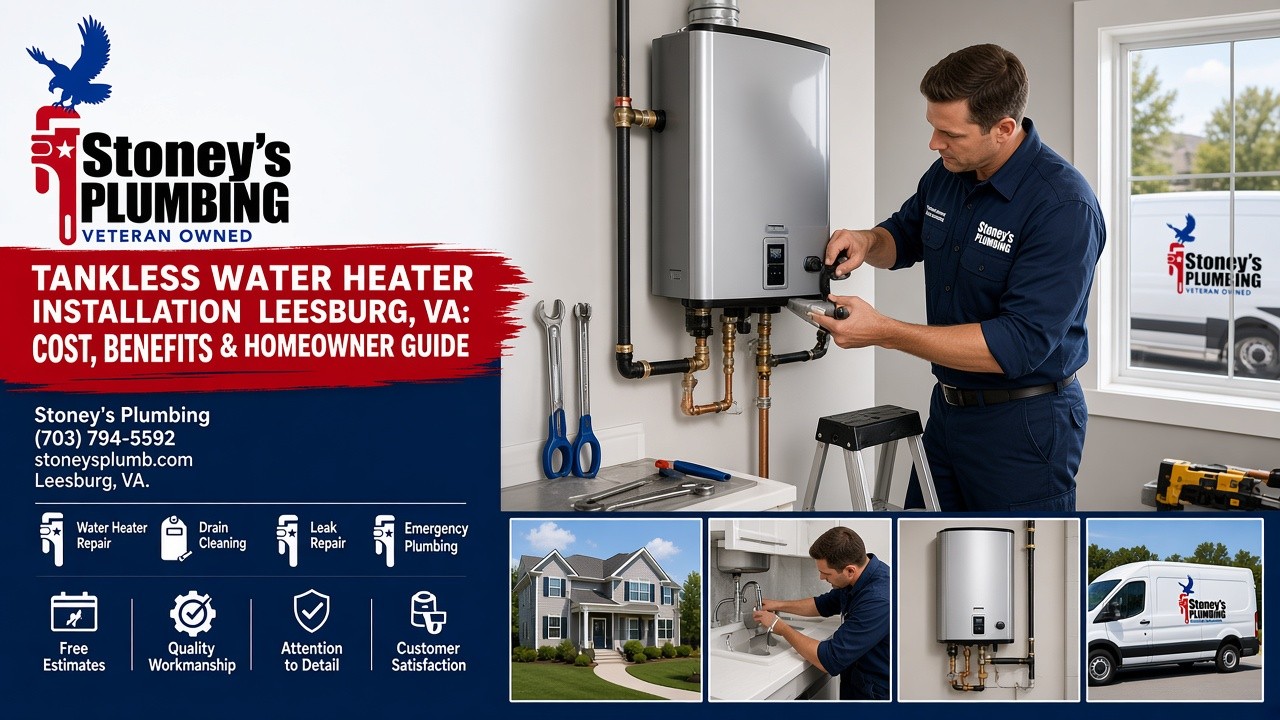
Stoney’s Plumbing · Tankless Water Heater Installation Guide
A tankless water heater promises continuous hot water, lower standby energy loss and a lot more floor space. For many Leesburg homes it delivers. For others, the upgrade costs more than expected because of gas line sizing, venting, electrical service or hard water. Tankless water heater installation in Leesburg works best when you know the real numbers before you commit. This guide explains how tankless units work, how they compare with tank and hybrid heaters, honest benefits and downsides, how to size a unit for Loudoun County winters, gas versus electric, educational cost ranges, gas line and venting requirements, permits, water quality, installation day, descaling and maintenance. Stoney’s Plumbing is a veteran-owned residential plumber at 574 Rockbridge Dr SE, Leesburg, VA 20175, and we answer calls 24/7.
Is tankless water heater installation in Leesburg, VA worth it, and what does it cost?
Tankless water heater installation in Leesburg is often worth it for households that want continuous hot water, plan to stay in the home for years and already have adequate gas service or room to upgrade it. As educational ranges, a gas tankless unit installed as a replacement for a gas tank often costs about $3,500 to $7,000, and more when the gas line, venting, condensate drain or electrical work needs upgrades. Whole-house electric tankless units can require major electrical service changes. These are general planning figures, not quotes.
The unit is only part of the job. Gas supply, venting, water quality and correct sizing decide whether a tankless heater performs the way you hoped.
Local context: Groundwater in Loudoun County gets cold in winter, which means a tankless unit has to raise the temperature more in January than in July. Many western Loudoun homes also have hard well water, which makes descaling and treatment more important. Call Stoney’s Plumbing at (703) 794-5592 or find our Leesburg office on Google Maps.
How a Tankless Water Heater Works
Quick answer: A tankless heater stays off until a hot tap opens. A flow sensor detects water movement, the burner or elements fire, and water is heated as it passes through a heat exchanger. When the tap closes, the unit shuts off. There is no stored tank of hot water to keep warm.
A traditional tank heater keeps 40 to 80 gallons hot all day, reheating whenever the temperature drops. A tankless heater, sometimes called an on-demand heater, heats only what you use, when you use it. That is why it can save energy and why it never “runs out” the way a tank does.
Inside a gas unit, a modulating burner adjusts its firing rate to match the flow and the required temperature rise. Condensing models add a second heat exchanger that captures heat from the exhaust, which raises efficiency and produces acidic condensate that must be drained. Non-condensing models are simpler but need metal venting that can handle hot exhaust.
Electric tankless units use heating elements instead of a burner. They are compact and need no venting, but heating a whole house’s worth of water electrically takes a lot of amperage. Small point-of-use electric units under a sink are a different and much simpler product.
The key limit for any tankless heater is flow. It can heat a certain number of gallons per minute by a certain number of degrees. Ask for too much flow on a cold day and the water comes out cooler, or the unit limits flow to hold temperature. Sizing, covered below, is about matching that limit to your home.
Tank vs. Tankless vs. Hybrid
Quick answer: Tank heaters cost the least up front and are simple to replace. Tankless heaters cost more to install but offer continuous hot water, a smaller footprint and a longer expected life. Hybrid heat pump heaters are very efficient electric tanks that need space and airflow.
| Factor | Gas or electric tank | Gas tankless | Hybrid heat pump |
|---|---|---|---|
| Up-front installed cost | Lowest | Higher | Moderate to higher |
| Hot water supply | Limited by tank size | Continuous within flow limit | Limited by tank, slower recovery |
| Typical lifespan | About 8 to 12 years | Often 15 to 20 years with care | About 10 to 15 years |
| Space needed | Floor space | Wall mounted, compact | Floor space plus air volume |
| Maintenance | Flush yearly | Descale yearly or as needed | Filter cleaning, flush |
| Power outage | Gas tank often still works | Needs electricity to run | Needs electricity |
No option is best for every house. A family that runs out of hot water every morning may love tankless. A couple with a basement full of space and a modest budget may be better off with a new tank. We cover the tradeoffs in more depth in our comparison of tank, tankless and hybrid heaters in Northern Virginia.
Benefits of Going Tankless
Quick answer: The main benefits are continuous hot water within the unit’s flow rating, lower standby energy loss, a compact wall-mounted footprint, a longer expected service life and the elimination of a large tank that can fail and flood a room.
- Continuous hot water. Back-to-back showers and a full bath no longer drain a tank.
- Lower standby loss. No tank losing heat all day and night.
- Space savings. A unit about the size of a carry-on suitcase hangs on the wall, freeing floor space in a basement, closet or garage.
- Longer life. With regular descaling, many units last 15 years or more, compared with roughly a decade for a tank.
- No tank to burst. A failing tank can release dozens of gallons. Tankless failures are usually smaller leaks.
- Precise temperature. Digital controls hold a set temperature well within the flow limit.
- Replaceable parts. Many components can be repaired rather than replacing the whole unit.
Energy savings depend on your hot water use and fuel prices. Households that use moderate amounts of hot water often see the clearest percentage savings because standby losses make up a bigger share of a tank’s energy use.
Honest Downsides of Tankless
Quick answer: Tankless heaters cost more up front, may need gas line, venting and electrical upgrades, need regular descaling, can deliver lukewarm water if undersized, have a minimum flow to fire, and do not deliver hot water faster to distant taps without recirculation.
- Higher up-front cost. Often two to three times the cost of a straight tank swap.
- Infrastructure upgrades. Many gas units need a bigger gas line and new venting.
- Cold-water sandwich. Brief bursts of cooler water can occur when a tap is turned off and on again quickly.
- Minimum flow. Very low flows, such as a trickle at a bathroom sink, may not trigger the burner.
- Flow limits. Running many fixtures at once on a cold day can exceed the unit’s capacity.
- Descaling. Hard water can scale a heat exchanger quickly without maintenance.
- Power dependence. Gas tankless units need electricity for controls and fans, so they stop during an outage unless backed up.
- Wait time is the same. Hot water still has to travel through the pipes.
None of these are reasons to rule tankless out, but each one should be addressed in the quote. If a quote ignores gas sizing or venting, ask why.
Is Tankless a Good Fit for Your Home?
Quick answer: Tankless is a strong fit if you run out of hot water often, plan to stay several years, have natural gas or propane with room for a larger line, have a good exterior wall for venting and are willing to descale. It is a weaker fit for short stays, very tight budgets or homes needing major electrical work for an electric unit.
| Good signs for tankless | Reasons to think twice |
|---|---|
| Frequent hot water shortages | Planning to sell within a couple of years |
| Natural gas or propane service | All-electric home with limited panel capacity |
| Tank is near an exterior wall | Heater sits in the center of a finished basement far from walls |
| Want floor space back | Budget only allows a straight tank swap |
| Willing to descale or install a softener | Very hard well water with no treatment plan |
| Large soaking tub or multiple showers | Very low hot water use |
If your current tank is still working and not very old, there is no rush. Planning a tankless upgrade before the tank fails lets you compare quotes calmly instead of choosing under pressure. Our article on deciding whether to repair or replace a water heater can help you time the change.
Sizing a Tankless Heater for Loudoun Winters
Quick answer: Size a tankless heater by peak flow and temperature rise. Add up the gallons per minute of the fixtures you run at the same time, then find a unit that can deliver that flow while raising winter groundwater, often in the 40s °F in Northern Virginia, to about 120 °F. A temperature rise of 70 to 80 °F is a common design point.
Sizing is where tankless installations most often go wrong. A unit that seems large on paper may fall short on a cold January morning when incoming water is near its coldest.
Step 1: Estimate peak flow
| Fixture | Typical hot water flow |
|---|---|
| Showerhead (low-flow) | About 1.5 to 2.0 GPM |
| Bathroom faucet | About 0.5 to 1.0 GPM |
| Kitchen faucet | About 1.0 to 1.5 GPM |
| Dishwasher | About 1.0 to 1.5 GPM |
| Clothes washer (warm) | About 1.5 to 2.0 GPM |
| Large tub filler | About 4 GPM or more |
A family with two showers running and the dishwasher on might need 5 to 6 GPM of hot water at once. Add a large tub and the number climbs.
Step 2: Find your temperature rise
Subtract incoming water temperature from your target. If winter groundwater is about 45 °F and you want 120 °F, you need a 75 °F rise. In summer the rise is smaller, so the unit performs better.
Step 3: Match the unit
Manufacturers publish flow charts showing GPM at different temperature rises. A unit rated around 9 to 10 GPM at a modest rise may deliver closer to 5 to 6 GPM at a 75 °F rise. Very large homes sometimes use two units linked together.
Ask your installer to show the flow at your winter temperature rise, not just the maximum GPM on the box. That one question prevents most “lukewarm shower” complaints.
Gas vs. Electric Tankless
Quick answer: Gas tankless units, on natural gas or propane, handle whole-house demand well but need adequate gas supply and venting. Whole-house electric units need no venting but can require very large electrical capacity, often several large breakers, which many homes cannot provide without a service upgrade.
Many Leesburg neighborhoods have natural gas, while some rural Loudoun homes use propane or are all-electric. The fuel you already have usually decides the best path.
| Factor | Gas tankless | Electric tankless |
|---|---|---|
| Whole-house capacity | Strong | Limited in cold climates |
| Venting | Required | None |
| Fuel supply work | Often a larger gas line | Often a panel or service upgrade |
| Unit cost | Higher | Lower |
| Best use | Whole-house heating | Point-of-use or small homes |
Electric whole-house units can draw well over 100 amps at full output. Before choosing one, have an electrician confirm your panel and service. In many homes, a hybrid heat pump tank is the more practical efficient electric option. For gas homes, our gas line safety and hookup guide covers how gas lines are planned and inspected.
Tankless Water Heater Installation Cost Ranges
Quick answer: As educational ranges, replacing a gas tank with a gas tankless unit installed often costs about $3,500 to $7,000. Jobs that need a new gas line run, new venting through a different wall, a condensate pump or electrical work can push higher. Whole-house electric tankless costs vary widely depending on electrical upgrades. These are not quotes.
| Project type | Educational installed range | What drives the cost |
|---|---|---|
| Gas tank to gas tankless, straightforward | About $3,500 to $5,000 | Unit, venting kit, valves, permit |
| Gas tank to gas tankless with gas line upgrade | About $4,500 to $7,000 | Larger gas pipe, possible meter coordination |
| Relocating the heater or new vent path | About $5,500 to $7,000 or more | Extra piping, wall penetrations, finishes |
| Two linked units for large homes | Often $7,000 or more | Two units, manifold, larger gas supply |
| Whole-house electric tankless | Varies widely | Panel or service upgrade, large breakers |
| Recirculation pump add-on | Often several hundred dollars and up | Pump type, return line or crossover valve |
Unit prices vary by brand, capacity and whether the unit is condensing. Labor is a large share, because the job involves gas, water, venting, electrical and sometimes drywall work. Permit fees in Loudoun County and Leesburg are usually a small part of the total.
When comparing quotes, line items matter more than the bottom number. Ask each installer to state the unit model and its flow at your winter temperature rise, gas pipe size and length, vent type and route, condensate handling, isolation valves for descaling, permit and inspection, haul-away of the old tank and any patching. For tank replacement prices as a comparison point, see our 2026 water heater replacement price ranges for Northern Virginia.
Utility rebates and federal energy incentives sometimes apply to high-efficiency water heaters. Programs change, so check current rules before counting on them.
Gas Line Sizing for Tankless Heaters
Quick answer: Whole-house gas tankless units often need far more gas at full fire than a tank heater, commonly up to about 150,000 to 199,000 BTU per hour versus about 40,000 for a typical tank. The existing half-inch line often cannot supply that, so many installs need a larger gas pipe from the meter or main branch.
Undersized gas supply is one of the most common causes of poor tankless performance. The unit may light fine at low flow but struggle, error out or deliver cooler water when several fixtures run.
Gas pipe sizing depends on the total BTU load of every gas appliance, the length of pipe from the meter and the pipe material. A plumber uses code sizing tables to choose the right diameter. Common outcomes include:
- Existing line works. Sometimes the heater is close to the meter and the line is already large enough.
- New dedicated line. A new run of larger black iron or CSST from the meter to the heater.
- Meter capacity check. In some cases the gas utility must confirm or upgrade the meter.
- Propane tank and regulator check. Propane homes need adequate tank size and regulator capacity.
Gas work requires a permit and inspection, and CSST must be bonded per code. If a quote does not mention gas sizing, ask how they confirmed the existing line is adequate. If you ever smell gas, leave the home and call the gas utility from outside.
Venting and Condensate
Quick answer: Gas tankless heaters cannot use a tank heater’s existing chimney or B-vent in most cases. Condensing units usually vent with PVC or polypropylene through a side wall or roof and need a condensate drain, often with a neutralizer. Non-condensing units need stainless steel venting rated for their exhaust.
Venting is a safety system, so it has to follow the manufacturer’s instructions and code exactly. Wrong materials, too many elbows or poor terminations can lead to failures or carbon monoxide risk.
| Item | Condensing tankless | Non-condensing tankless |
|---|---|---|
| Vent material | PVC, CPVC or polypropylene per manual | Category III stainless steel |
| Efficiency | Higher | Lower |
| Condensate drain | Required, often with neutralizer | Usually not required |
| Vent cost | Lower material cost | Higher material cost |
Vent terminations need clearance from windows, doors, decks, grade and gas meters. In Leesburg’s townhouse communities, the nearest exterior wall may face a neighbor’s patio or a walkway, which affects where the vent can go. Some HOAs have rules about visible vent caps. Condensate can be routed to a floor drain or a condensate pump. In cold weather, poorly placed condensate lines outdoors can freeze, so indoor drainage is preferred.
Old chimneys left without a water heater connected may need a liner change if a furnace still uses them. A good installer checks this rather than leaving an orphaned flue problem behind.
Where to Mount a Tankless Water Heater
Quick answer: The best location is near the existing water heater spot, on or close to an exterior wall for short venting, close to the gas supply, with a drain for condensate and relief discharge, an outlet, and protection from freezing. Outdoor-rated models exist but need freeze protection in Loudoun winters.
- Near existing plumbing. Reusing the hot and cold lines keeps costs down.
- Near an exterior wall. Shorter vents mean fewer elbows and lower cost.
- Close to the gas source. Shorter gas runs make sizing easier.
- Drain access. For condensate and the relief valve discharge.
- Electrical outlet. Gas tankless units need power for controls and fans.
- Service clearance. Room to open the cover and connect descaling hoses.
Moving the heater to a new spot can shorten hot water wait times or free a closet, but it adds piping and patching. In garages, protect the unit and lines from freezing and from vehicle impact.
Permits, Code and Inspections
Quick answer: Replacing a water heater with a tankless unit generally requires a plumbing permit, and gas and electrical work may need their own permits. Work must follow the Virginia Uniform Statewide Building Code and the manufacturer’s instructions, and an inspection confirms gas, venting, relief valve and connections.
In Loudoun County, permits are handled through the county’s building permit process, and the Town of Leesburg area follows the county process for most residential trade permits. You can find general information on the Loudoun County building permits page, and the state code is administered through the Virginia DHCD building codes office.
Inspectors typically look at:
- Gas pipe sizing, material, bonding and leak testing.
- Vent material, length, terminations and clearances.
- Temperature and pressure relief valve and its discharge line.
- Combustion air where applicable.
- Condensate disposal.
- Water connections, shutoffs and any expansion control required.
- Electrical connection.
Permitted work protects you when you sell the house and helps make sure safety systems are right. Ask any installer whether the permit is included and who schedules the inspection. You can confirm a contractor’s license through the Virginia DPOR license lookup.
Hard Water and Tankless Heaters
Quick answer: Hard water leaves scale in a tankless heat exchanger, reducing efficiency and triggering error codes. Homes with moderate to high hardness, common on many western Loudoun wells, should plan on regular descaling and often a water softener or scale-prevention system ahead of the heater.
A tankless heat exchanger has narrow passages that heat water intensely, which is exactly where calcium and magnesium drop out. Scale acts like insulation, so the burner works harder and the exchanger can overheat over time.
Check your water before installation. The Town of Leesburg and Loudoun Water’s resources for protecting home plumbing are good starting points for public water customers. Well owners should test. Options include:
- Descaling only. Fine for softer water, typically yearly.
- Scale-prevention cartridge. A small inline unit ahead of the heater for moderate hardness.
- Whole-house softener. The strongest protection for hard water, which also helps fixtures and appliances.
For testing, sizing and cost ranges on softeners, see our Leesburg guide to hard water and softener systems. Installing a softener and a tankless heater together is common and can save on labor.
Condensing vs. Non-Condensing Units
Quick answer: Condensing tankless heaters capture extra heat from exhaust, reaching higher efficiency and using plastic venting, but they need a condensate drain. Non-condensing units cost less up front but need stainless steel venting and run somewhat less efficiently. For most Leesburg whole-house installs, condensing models are the more common choice.
The difference comes down to what happens to the exhaust. In a non-condensing unit, hot exhaust leaves through the vent carrying heat with it. In a condensing unit, a secondary heat exchanger cools the exhaust until water vapor condenses, recovering energy that would otherwise be lost. That condensate is mildly acidic, which is why a neutralizer is often installed before it reaches a drain.
Because condensing exhaust is cool, it can travel through PVC or polypropylene pipe, which is cheaper and easier to route than stainless steel. That often offsets part of the higher unit price. Non-condensing units can make sense where no drain is available and the vent run is short, but those situations are less common.
Both types modulate their burners to match demand. Look at the minimum flow rate too: a lower minimum helps the unit fire at a bathroom sink with a gentle flow, reducing complaints about cold water at low flows.
Valves, Pressure and Expansion
Quick answer: A good tankless install includes isolation valves with service ports for descaling, a temperature and pressure relief valve piped to a safe location, a sediment or inlet screen, and attention to water pressure. Homes with high street pressure may need a pressure reducing valve, and some systems still need thermal expansion control.
Isolation valve kits are a small cost that makes yearly descaling simple. Without them, each maintenance visit becomes a bigger job. The relief valve protects against excess pressure and must discharge where it will not scald anyone or damage the home.
Water pressure also matters. Very high pressure strains every fixture and appliance, while low pressure can keep a tankless unit from reaching full output. If you already notice weak flow, start with our article on diagnosing weak water pressure in Leesburg homes before blaming the heater.
Thermal expansion is smaller with tankless heaters because there is little stored hot water, but homes with check valves or pressure reducing valves on the main may still have expansion considerations depending on the full system. Your installer should assess the whole setup rather than only the heater.
Electrical Needs for Gas Tankless Units
Quick answer: Gas tankless heaters need a standard 120-volt outlet or circuit for their controls, fan and freeze protection. Many old gas tank heaters had no electrical connection at all, so adding an outlet near the new unit is a common line item.
The electrical load for a gas unit is small, but the outlet must be in the right place and meet code. In garages and unfinished basements, GFCI protection may be required. If you want the heater to keep running during outages, ask about a battery backup sized for the unit or connecting the circuit to a generator. Built-in freeze protection heaters also draw power in winter, so an unplugged unit in a cold space is at risk.
Whole-house electric tankless units are a different matter, as covered above, and need an electrician’s load calculation before purchase.
Thinking About a Tankless Water Heater?
Call Stoney’s Plumbing at (703) 794-5592. We are a veteran-owned local plumber in Leesburg, and we answer calls 24/7. We will look at your gas supply, venting options and water quality, size the unit for winter conditions, and give you the full scope and price before installation begins.
What Happens on Installation Day
Quick answer: A typical tank-to-tankless conversion takes most of a day, longer when gas lines or vents are rerouted. Water and gas are off for part of the job. The plumber drains and removes the old tank, mounts the unit, runs gas, water, venting and condensate, adds service valves, tests for leaks, fires the unit, sets the temperature and walks you through it.
- Walkthrough. Confirm the mounting spot, vent route, gas path and drain.
- Shutoffs. Gas and water off, old tank drained.
- Removal. Old tank disconnected and hauled away.
- Mounting. Unit secured to the wall, often on a backer board.
- Gas and water. New gas line if needed, water lines with isolation valves for descaling.
- Venting. Wall or roof penetration sealed and terminated with proper clearances.
- Condensate. Drain line, neutralizer or pump as needed.
- Testing. Gas leak test, water leak check, first firing and flow check at several fixtures.
- Handoff. Temperature setting, how to read error codes and how descaling works.
Plan to be without hot water for the day. If a permit inspection is required after installation, the inspector may visit later. For general timing on plumbing projects, our article on typical plumbing job durations in Leesburg gives helpful context, and the best seasons to schedule plumbing work article explains why planning ahead of winter helps.
Descaling and Maintenance
Quick answer: Most tankless heaters should be descaled about once a year, more often with hard water. Descaling circulates a mild acid solution, often food-grade vinegar or a manufacturer-approved descaler, through the heat exchanger using the isolation valves. Also clean the inlet screen, check the vent and condensate drain, and test the relief valve.
Regular maintenance is the biggest factor in how long a tankless heater lasts. Skipping it on hard water is the fastest way to shorten its life.
| Task | How often | Who |
|---|---|---|
| Descale heat exchanger | Yearly, or more with hard water | Homeowner with kit or plumber |
| Clean inlet water filter screen | Every few months to yearly | Homeowner |
| Check vent termination for blockage | Seasonally, especially after snow | Homeowner |
| Check condensate line and neutralizer | Yearly | Homeowner or plumber |
| Test relief valve | Yearly | Homeowner or plumber |
| Combustion and gas pressure check | Every year or two | Plumber |
A basic descaling process: turn off power and gas, close the isolation valves, connect a small pump and hoses to the service ports, circulate descaler for the time the manual recommends, flush with fresh water, clean the inlet screen and restore service. Many homeowners do this themselves. Others prefer a yearly visit. Some units display a scale warning when it is time.
After snowstorms, clear snow from side-wall vent terminations. A blocked intake or exhaust will shut the unit down.
Energy Use and Operating Costs
Quick answer: Tankless heaters avoid standby losses, so they generally use less energy than a comparable gas tank, but savings depend on how much hot water you use and fuel prices. Payback from energy savings alone often takes many years, so comfort, space and longer life are usually part of the decision.
Energy guides for water heaters show annual operating cost estimates, and condensing tankless models are among the most efficient gas options. However, a household that takes long showers because hot water never runs out may use more water and some of the savings disappear.
A fair way to think about it:
- Energy savings. Often a modest annual reduction compared with an older tank.
- Longer life. Fewer replacements over 20 years.
- Space value. Reclaimed floor space for storage or finishing.
- Reduced flood risk. No large tank failure.
Water efficiency matters too. Low-flow showerheads and fixing leaks help any water heater perform better. The EPA WaterSense leak-fixing resources offer practical tips for cutting wasted water. For broader thinking on value, see how plumbing upgrades can affect home value.
Recirculation and Hot Water Wait Times
Quick answer: A tankless heater does not shorten the wait for hot water at a distant faucet. Water still travels through the pipes. Many units offer built-in recirculation or work with an external pump and crossover valve to keep hot water closer to fixtures, at some extra energy and cost.
In larger Loudoun homes, the master bath may be 50 feet or more of pipe from the heater. Recirculation options include:
- Dedicated return line. The most effective, common in some newer homes.
- Crossover valve under a sink. Uses the cold line as a return, with some lukewarm cold water as a tradeoff.
- Built-in recirculation pump. Some tankless models include one with scheduling.
- On-demand button or sensor. Runs the pump only when you are about to use hot water, saving energy.
If wait times bother you now, mention it during the quote. Adding recirculation during installation is usually easier than later.
Propane Tankless in Rural Loudoun
Quick answer: Propane tankless heaters work much like natural gas models but use a propane-specific unit or conversion. The propane tank, regulators and supply line must deliver enough fuel at full fire, especially in cold weather when tank pressure drops.
Many homes west of Leesburg, toward Purcellville, Lovettsville and Round Hill, rely on propane. Tankless can be a good fit there, since it avoids heating a large tank of water with an expensive fuel all day. A few points need attention:
- Tank size. Small tanks may not vaporize enough propane on very cold days for a large tankless load.
- Regulators. First and second stage regulators must handle the added load.
- Supply line. Line size and length matter as much as with natural gas.
- Coordination. Your propane supplier may need to confirm tank and regulator capacity.
Combined with hard well water, propane homes benefit most from planning the softener, the heater and fuel supply as one project.
Point-of-Use Tankless Units
Quick answer: Small electric point-of-use tankless heaters sit under a sink or near a fixture to deliver hot water quickly at one location. They are useful for a distant bathroom, a basement bar sink or a garage, not as a replacement for a whole-house heater.
Point-of-use units are compact and often run on a standard dedicated circuit. They can solve a long wait at a faraway sink without a recirculation pump. Some homeowners pair a central tank or tankless heater with one or two point-of-use units for distant fixtures.
Before adding one, confirm electrical capacity and space. Fixture upgrades often happen at the same time; our article on timing fixture replacements in Leesburg can help you plan.
Winter Freeze Protection
Quick answer: Most tankless units include electric freeze protection, which only works with power. Units in garages, crawlspaces or outdoors need insulated lines, power and, for long outages, draining to prevent a cracked heat exchanger.
Loudoun winters bring stretches of freezing nights. Indoor units in heated spaces rarely have trouble. Units in unheated spaces need insulated water lines, a reliable outlet and a plan for outages. If power is out for a long time in deep cold, shut off water and gas and drain the unit through the service valves. Our guide to small repairs around Leesburg homes covers simple winter prep for other fixtures too.
Tankless Troubleshooting
Quick answer: Lukewarm water usually points to overdemand, scale, a clogged inlet screen or undersized gas. No hot water can mean a power, gas or ignition issue, a blocked vent or an error lockout. Check the display code, the vent and the inlet screen first, then call a plumber.
| Symptom | Common causes | First steps |
|---|---|---|
| Lukewarm water with several taps open | Demand above unit capacity | Run fewer fixtures, check sizing |
| Temperature swings | Low flow, scale, mixing valve | Clean screen, descale |
| No hot water | Power, gas supply, ignition, error lockout | Check breaker, gas valve, display code |
| Unit shuts off in snow | Blocked vent or intake | Clear the termination |
| Error code for scale | Mineral buildup | Descale |
| Water near unit | Condensate line, fitting or relief valve | Close valves, call |
During a power outage, a gas tankless unit will not run unless it has backup power. Some homeowners connect a small battery backup or generator circuit. A leak at the heater is worth a call; close the cold water isolation valve to limit damage.
Choosing a Tankless Installer
Quick answer: Choose a licensed plumber who sizes the unit for winter temperature rise, checks gas pipe sizing, plans venting to the manufacturer’s manual, pulls the permit, installs isolation valves and explains maintenance. Compare written quotes line by line.
Questions worth asking:
- What flow will this unit deliver at our winter temperature rise?
- Is our current gas line large enough, and how did you check?
- What vent material and route will you use, and where will it terminate?
- How will condensate be handled?
- Are isolation valves for descaling included?
- Is the permit included, and who schedules inspection?
- What does the manufacturer require for maintenance?
- What will you do if our water is hard?
Clear answers are a good sign. For more on picking a contractor, read our advice on choosing a local plumbing company and the pre-hire checklist for honest plumbers.
Tankless Myths
Quick answer: Tankless heaters do not give truly unlimited hot water to every fixture at once, do not deliver hot water instantly at faraway taps, and are not maintenance-free. They also do not always pay for themselves on energy alone.
- “Unlimited hot water for everything.” Continuous, yes, but limited by flow rate.
- “Instant hot water.” Pipe length still matters.
- “No maintenance.” Descaling matters, especially with hard water.
- “Any plumber can just swap it in.” Gas, venting and condensate make it a bigger job than a tank swap.
- “Always cheaper to run.” Usually more efficient, but savings depend on use.
- “Electric tankless is an easy upgrade.” Whole-house electric often needs major electrical work.
Homeowner Checklist Before You Buy
Quick answer: Know your peak hot water use, fuel type, water hardness and possible vent locations. Ask each installer for flow at winter temperature rise, gas sizing, venting, condensate, valves and permit in writing.
- Count how many showers and appliances run at once at peak times.
- Note your fuel: natural gas, propane or electric.
- Find the age of your current heater from its label.
- Check water hardness from your utility report or a well test.
- Look for an exterior wall near the heater.
- Check for an outlet and drain near the heater.
- Ask about HOA rules on vent caps.
- Decide whether you want recirculation.
- Collect at least two detailed written quotes.
Common Leesburg Tankless Scenarios
Quick answer: Most local tankless projects fall into a few patterns: a family running out of hot water, an aging tank in a townhouse, a well home with hard water, an all-electric home, and a basement finishing project. Each points to a different plan.
Family running out of hot water
A household of five in a single-family home near Leesburg runs out of hot water every morning with a 50-gallon gas tank. A properly sized gas tankless unit, with a gas line upgrade if needed, usually solves this, as long as it is sized for winter.
Aging tank in a townhouse
A 12-year-old tank sits in a utility closet with limited space. A wall-mounted tankless unit frees room, but the vent route through the exterior wall and HOA rules need checking first. Sometimes a new tank is the more practical choice here.
Hard water on a well in western Loudoun
A home near Hamilton has very hard well water. Tankless can work well, but only with a softener or scale-prevention system and regular descaling. Plan both together.
All-electric home
A home without gas service is curious about tankless. A whole-house electric unit may need a costly electrical upgrade. A hybrid heat pump tank or point-of-use electric units for distant fixtures may be better values.
Finishing the basement
Homeowners finishing a basement want to reclaim the space a tank occupies. Moving to a wall-mounted tankless unit near an exterior wall during the renovation is often efficient, since walls are already open.
Second-floor laundry and large tub
A newer Ashburn-area home has a second-floor laundry, three full baths and a large soaking tub. Peak demand can exceed 8 GPM in winter. Two linked tankless units, or one large unit paired with a recirculation pump and careful scheduling, are typical approaches. A detailed sizing discussion before purchase keeps the tub from filling lukewarm on cold mornings.
If your tank fails suddenly, you may need hot water fast. A replacement tank can get you through, and you can plan a tankless upgrade later. Our full Leesburg water heater replacement walkthrough covers that path.
Stoney’s Plumbing
Quick answer: The right water heater starts with honest sizing. Stoney’s Plumbing is a veteran-owned residential plumber at 574 Rockbridge Dr SE, Leesburg, VA 20175, available 24/7. Call (703) 794-5592.
We help Leesburg and Loudoun County homeowners with tankless and tank water heater installation, replacement and repair, water treatment and the gas and water lines that serve them. We explain how our pricing works, give you the scope and price before repair work begins, and tell you plainly when something can wait.
Visit Stoney’s Plumbing online or open Stoney’s Plumbing in Google Maps. Address: 574 Rockbridge Dr SE, Leesburg, VA 20175. For urgent problems, see 24/7 emergency plumbing in Leesburg, with local after-hours pages for Ashburn after-hours water heater help, Sterling after-hours water heater help, Purcellville after-hours water heater help, Loudoun County after-hours water heater help. We also help nearby homeowners: Ashburn water heater help, Sterling water heater help, Purcellville water heater help, Loudoun County water heater help, Lansdowne and River Creek water heater help, Aldie and South Riding water heater help, Hamilton and Round Hill water heater help.
Frequently Asked Questions About Tankless Water Heaters in Leesburg
Is a tankless water heater worth it in Leesburg, VA?
It is often worth it if you run out of hot water, plan to stay in the home for years, have natural gas or propane and can descale regularly. If you plan to move soon or your budget only allows a tank swap, a new tank may be the better value.
How much does tankless water heater installation cost in Leesburg?
As educational ranges, replacing a gas tank with a gas tankless unit installed often costs about $3,500 to $7,000. Gas line upgrades, new venting, relocation or two linked units can push higher. These are planning figures, not quotes.
What size tankless water heater do I need?
Add up the hot water flow of fixtures you run at once, then choose a unit that delivers that flow at your winter temperature rise, often about 70 to 80 degrees Fahrenheit in Northern Virginia. Many families need about 5 to 7 gallons per minute at that rise.
Do I need a bigger gas line for a tankless water heater?
Often, yes. Whole-house gas tankless units can use up to about 199,000 BTU per hour at full fire, far more than a typical tank. A plumber sizes the gas pipe by total load and length to confirm whether an upgrade is needed.
Can a tankless heater use my old water heater vent?
Usually not. Condensing tankless units vent with PVC or polypropylene through a side wall or roof, and non-condensing units need stainless steel venting. The vent must follow the manufacturer’s manual and code.
Does a tankless water heater need a permit in Loudoun County?
Generally, yes. Water heater replacement typically needs a plumbing permit, and gas or electrical work may need permits too. An inspection confirms gas, venting, relief valve and connections.
How often should a tankless water heater be descaled?
About once a year for most homes, and more often with hard water. Descaling circulates a mild acid solution through the heat exchanger using isolation valves, then flushes it with fresh water.
Do I need a water softener with a tankless water heater?
Not always, but homes with moderate to high hardness, including many western Loudoun wells, benefit from a softener or scale-prevention system to protect the heat exchanger and reduce descaling.
How long does a tankless water heater last?
With regular descaling and maintenance, many tankless units last about 15 to 20 years, compared with roughly 8 to 12 years for a typical tank heater.
Will a tankless heater give me hot water instantly?
No. Hot water still has to travel through the pipes, so wait times are similar. A recirculation system can shorten the wait at distant fixtures.
Does a gas tankless water heater work during a power outage?
Not without backup power. Gas tankless units need electricity for controls and fans. A battery backup or generator circuit can keep them running.
Is electric tankless a good choice for a whole house?
It can be in small homes or mild climates, but whole-house electric units often need very large electrical capacity. Many Loudoun homes would need a panel or service upgrade, so a hybrid heat pump tank is often more practical.
How long does tankless installation take?
A straightforward tank-to-tankless conversion usually takes most of a day. Gas line upgrades, new vent routes or relocation can extend it.
Does Stoney’s Plumbing answer calls 24/7?
Yes. Stoney’s Plumbing answers calls 24/7 at (703) 794-5592. Tankless installation is usually scheduled during regular hours, but a leaking water heater is worth a call any time.
Where is Stoney’s Plumbing located?
Stoney’s Plumbing is located at 574 Rockbridge Dr SE, Leesburg, VA 20175. We are a veteran-owned residential plumber helping homeowners in Leesburg, Loudoun County and Northern Virginia. Call (703) 794-5592.
Find Stoney’s Plumbing in Leesburg
Plan Your Tankless Upgrade the Right Way
Get the sizing, gas and venting right from the start. Call Stoney’s Plumbing at (703) 794-5592. We are a veteran-owned local plumber in Leesburg, available 24/7, and we give you the scope and price before installation begins.
574 Rockbridge Dr SE, Leesburg, VA 20175 · Serving Leesburg, Loudoun County & Northern Virginia