
Stoney’s Plumbing · Service Comparison Guide
Leesburg homeowners rarely need every plumbing service at once. They need the right one for the symptom in front of them: no hot water, a slow kitchen sink, a wet ceiling, or a floor drain that gurgles after a storm. This guide compares the plumbing services Leesburg and Loudoun County homes request most often—water heaters, drains, leak detection and repair, and sewer lines—so you can tell which path fits the problem, what urgency looks like, and which work usually needs a licensed plumber versus careful DIY. Stoney’s Plumbing is a veteran-owned residential plumber based at 574 Rockbridge Dr SE, Leesburg, VA 20175.
Which plumbing service does a Leesburg home need first?
Match the service to the symptom, not to a menu of upgrades. No hot water or scalding swings usually point to water-heater diagnosis. One slow fixture with clear grease or hair history often starts as drain cleaning. Active drips, unexplained high bills, or wet spots point to leak detection and repair. Multiple fixtures backing up, outdoor cleanout overflow, or sewage odor point toward the sewer lateral or main line. The cost and timing figures on this page are educational ranges based on typical residential work, not quotes from Stoney’s Plumbing and not a price list. Only an on-site diagnosis can speak to your house.
Local context: Leesburg mixes historic downtown stock, mid-century neighborhoods, and newer Loudoun subdivisions. Galvanized and cast-iron leftovers, hard water, freeze risk, and well or septic properties west of town change how the same symptom behaves. For the wider hiring map, see our complete 2026 Leesburg plumber guide for homeowners. For duration expectations, read how long a plumbing repair typically takes in Leesburg. Call (703) 794-5592 or view Stoney’s Plumbing on Google Maps.
How to Compare Plumbing Services Without Guessing
Quick answer: Compare services by the system they treat, the diagnostic step they require, the safety boundary, and the likely follow-on work—not by which service sounds most impressive. A drain snake cannot fix a leaking supply line. A water-heater swap cannot clear a collapsed sewer lateral. Start with the symptom, confirm the system, then pick the service path.
Homeowners often search for a catch-all “top-rated” label when what they really need is a clear path: which trade service matches this failure mode? Best plumbing services for Leesburg homes is a comparison question. It is not a popularity contest. The useful comparison asks four practical questions.
Which system failed?
Hot water production, fixture drainage, pressurized supply, or the building sewer that leaves the house.
What diagnostic is needed?
Visual check, camera inspection, pressure or meter test, combustion or electric heater checks, or excavation planning.
Where is the safety line?
Gas, venting, main shutoff, sewage exposure, and permitted scopes belong with a licensed plumber.
Those four questions keep you from buying the wrong ticket. If laundry and toilets back up together, buying a new kitchen faucet will not help. If the water heater tank is weeping at the base, scheduling another drain cleaning will not help. If a second-floor supply line is staining the dining-room ceiling, a sewer camera is the wrong first tool—unless you also have separate sewer symptoms.
Stoney’s service pages map to these paths: mechanical and water-heater work, drain cleaning in Leesburg, leak detection, and plumbing and drainage services. Use them as destination pages after you know which path fits. For saleability context when you are listing, see whether fixing plumbing problems protects home value in Leesburg.
Another comparison trap is treating every plumber visit as interchangeable. A faucet cartridge swap, a tank water-heater replacement, and a sewer lateral repair are different trades in practice even when one company can do all three. Scope, parts lead time, access, and permits differ. Comparing them as if they were the same “service call” produces bad expectations about time and cost. Our timing guide on when to schedule plumbing repairs in Leesburg helps with calendar planning once you know the path.
Finally, compare outcomes, not adjectives. “Thorough,” “premium,” and “complete” do not tell you whether the tech will test the relief valve, run a camera when multiple fixtures back up, or isolate a slab leak before cutting. Ask what diagnosis will be done, what options you will hear before work starts, and which scopes need Loudoun County trade permits. That is how you compare services in a way that protects the house.
Symptom-to-Service Map for Leesburg Homes
Quick answer: Use symptoms as a sorting hat. Isolated fixture issues usually stay local. Whole-house patterns usually point upstream to the water heater, the main drain or sewer, the pressure-reducing valve, or a supply leak. When two systems could explain the same symptom, diagnose before replacing expensive equipment.
| What you notice | Most likely service path | Less likely first path |
|---|---|---|
| No hot water, lukewarm showers, or sudden scalding swings | Water heater diagnosis (tank, tankless, or hybrid) | Drain cleaning |
| One sink or tub slow; others fine | Local drain cleaning / fixture trap work | Full sewer replacement |
| Several fixtures slow; toilets gurgle; outdoor cleanout weeps | Main drain or sewer evaluation (often camera) | Replacing the water heater |
| Wet ceiling, cabinet floor soft, hissing, unexplained high water use | Leak detection and repair | Routine drain snake “just in case” |
| Sewage odor near floor drains or yard soggy over the lateral | Sewer line inspection / cleaning / repair plan | Faucet upgrade |
| Whole-house low pressure | Supply diagnosis (PRV, meter, galvanized, well equipment) | Single aerator cleaning alone |
| Rotten-egg smell only on hot water | Water heater anode / bacterial odor diagnosis | Sewer camera as first step |
Northern Virginia homes add a few local twists. After freeze events, a wet spot that appears near an exterior wall may be a burst or cracked supply line rather than a drain issue—see Loudoun Water’s frozen-pipe guidance for prevention themes. After heavy rain, a basement floor drain that burps may be a sewer capacity or check-valve story rather than a kitchen grease clog. Historic Leesburg properties with mixed pipe materials can show both supply corrosion and drain scaling in the same house; that is two service paths, not one.
If the map still leaves two realistic options, choose the cheaper reversible diagnostic first when safety allows. A camera inspection or leak-isolation test is usually cheaper than replacing the wrong major component. The sections below walk each of the four core services in depth, then put them side by side.
Keep one more sorting rule in mind: water where it should not be and sewage where it should not be outrank inconvenience. A slightly slow guest-bath sink can wait a few days. A wet light fixture under a bathroom, sewage on a basement floor, or a gas water heater that will not light safely cannot. Urgency is covered later; the symptom map is only the first filter.
Water Heater Services: Repair, Flush, or Replace
Quick answer: Repair when a discrete part failed and the tank or heat exchanger is otherwise sound. Flush and maintain when sediment or hard water is degrading performance. Replace when the tank leaks, safety devices are compromised, or failures keep stacking. Tankless and hybrid units follow different diagnostic paths than standard tanks.
Water heaters are the service path people notice first because cold showers are hard to ignore. In Leesburg and Loudoun County homes you will see conventional storage tanks (gas or electric), tankless units, and a growing number of heat-pump or hybrid units. The service question is not “buy the nicest model.” It is “what failed, is it safe, and is repair still rational?”
Storage tank water heaters
Early stage. Longer recovery time, popping or rumbling from sediment, cloudy hot water, or a temperature that drifts can point to sediment, a failing thermostat or element (electric), a weak burner or thermocouple path (gas), or a tired dip tube. A professional diagnosis separates “flush and parts” from “tank is done.”
What happens if the heater keeps running untreated. Sediment accelerates tank wear. A leaking tank does not get better. A compromised temperature-and-pressure relief path is a safety issue, not a comfort issue. Ignoring small drips at fittings can soak flooring and create mold risk in utility closets and garages.
What a timely service visit looks like. Confirm fuel type and venting condition, test safety devices, measure performance, and explain repair versus replace before ordering a tank. If replacement is the honest path, ask whether a Loudoun County plumbing (and gas, if applicable) trade permit applies—see Loudoun County’s building permits page.
Tankless water heaters
Early stage. Error codes, cold-water sandwiches, scale-related flow cutbacks, and ignition failures are common complaint patterns. Hard water in parts of Loudoun makes descaling and inlet-filter maintenance more than optional housekeeping.
What happens if scaling wins. Heat exchangers suffer. Efficiency drops. Units lock out. Homeowners sometimes replace a tankless unit that needed descaling and a sensor—not a full swap.
What timely service looks like. Read codes, verify gas supply and venting clearances, check water quality assumptions, and service per manufacturer guidance before condemning the unit.
Heat pump / hybrid water heaters
Early stage. These units move heat from surrounding air into the tank. Complaints can include cool utility-room air, longer recovery in cold spaces, filter neglect, or mode settings that force expensive resistance heat. Efficiency expectations should track product class guidance such as ENERGY STAR’s water heater product pages, not a neighbor’s anecdote.
What happens if the install space is wrong. A hybrid in a tiny cold closet may underperform. That is an application problem as much as a “bad unit” problem.
What timely service looks like. Confirm mode, airflow, condensate handling, and whether the complaint is comfort, noise, or true failure—then repair, reconfigure, or discuss replacement honestly.
Repair-versus-replace rules of thumb stay conservative. A leaking tank is usually replace. A single failed electric element on an otherwise sound tank is often repair. Repeated parts failures on a 12–15-year tank in a hard-water home often tip toward replace. Gas venting and combustion concerns are never DIY experiments. For deeper local context, Stoney’s Leesburg water heater repair vs replacement study and the mechanical services page walk the same decision without inventing a one-size answer.
When you compare water-heater service to the other three paths on this page, remember what it cannot do. It will not clear a main sewer clog. It will not stop a slab leak. It will not raise whole-house static pressure if the PRV failed. Water-heater service is the right “best” service only when the failure is hot-water production or heater safety.
Drain Cleaning vs Recurring Clogs in Leesburg Homes
Quick answer: A single slow fixture with a clear grease, hair, or soap history often responds to professional snaking or localized clearing. Recurring backups across multiple fixtures, outdoor cleanout overflow, or sewage odor usually mean the main line or sewer lateral needs evaluation—not another round of store-bought chemicals. Camera inspection turns guesswork into a plan.
Drain service is the path homeowners request most often because sinks and tubs announce themselves daily. The mistake is treating every slow drain as the same job. Best plumbing services for drain problems in Leesburg homes split into at least three tiers: fixture-level clearing, branch-line work, and main-line or sewer work that overlaps the sewer section below.
Fixture-level clogs
Kitchen sinks often fail from grease, coffee grounds, and disposal abuse. Bathrooms fail from hair and soap scum. A plunger or a careful hand-auger attempt can clear some simple clogs. Chemical drain openers are a weak long-term strategy: they can damage older pipes and fittings, create hazardous splash risk, and leave partial blockages that return in days. If a fixture has backed up repeatedly in the same month, stop repeating the same household product and get a mechanical clearing plus a cause check.
Garbage disposals add a special case. A jam is not always a drain clog. Reset buttons, foreign objects, and failed motors are different repairs. Forcing a disposal while the line is blocked can push the problem deeper. When in doubt, shut power off before reaching into a disposal.
When “just snaking” is not enough
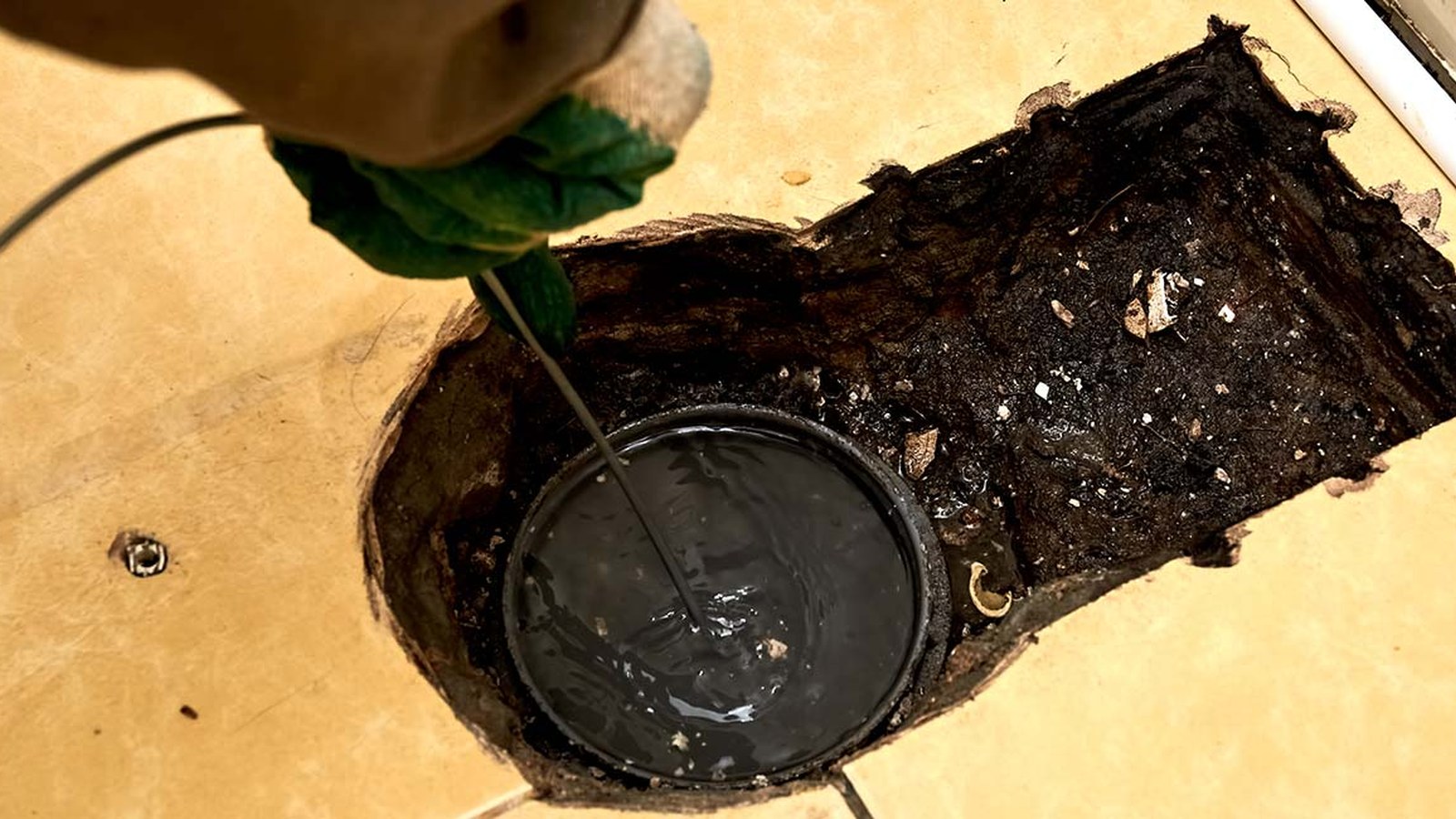
If two bathrooms back up when the washing machine drains, or a basement floor drain burps when an upstairs toilet flushes, you are past a single P-trap story. That pattern is why Stoney’s Leesburg sewer backup and drain cleaning study separates fixture clogs from sewer-side failures. A camera inspection after clearing can show grease shelves, scale in cast iron, root intrusion, bellies, or offsets. Clearing without looking is sometimes necessary in an active backup; looking afterward is what prevents the third emergency call.
| Pattern | Likely tier | Typical next tool |
|---|---|---|
| One sink slow; nearby fixtures fine | Local | Remove trap / local snake |
| Tub and lav slow on same bath stack | Branch | Accessible cleanout snake; check venting clues |
| Multiple fixtures; toilet gurgle; yard cleanout | Main / sewer | Main-line clearing + camera |
| Returns every few weeks in same spot | Cause unknown | Camera + material / grade assessment |
Hydro-jetting is a different tool from a cable snake. Cables punch a path; jets scrub walls when the pipe condition and access support it. Not every older Loudoun lateral is a jetting candidate on day one. A pro should explain why one method fits better than the other for your pipe material and blockage type.
DIY boundary for drains: plunging a single toilet or sink, cleaning a pop-up stopper, and avoiding grease down the kitchen sink are reasonable. Opening the main cleanout during an active sewage backup, running a large cable without training, or mixing chemical products is how homeowners create larger messes and injuries. Sewage exposure deserves gloves, eye protection, and a low tolerance for “I’ll just try one more bottle.”
Compare drain service to the leak path carefully. A wet cabinet under a kitchen sink can be a supply-line drip, a drain-tailpiece leak, or both. If the water appears only when the faucet runs and the trap is dry underneath between uses, think supply. If the cabinet floor gets wet mainly when the sink drains, think drain fittings. Wrong-path snaking will not dry a supply leak.
For scheduling, mild single-fixture clogs can often wait for ordinary business hours. Active sewage in living space cannot. See also professional drain cleaning for Leesburg homes when you already know the problem is drainage rather than supply.
Leak Detection and Repair: Finding Water That Should Not Be There
Quick answer: Leak service starts with locating the source before opening walls. Visible drips under sinks are the easy end. Hidden supply leaks, slab or crawlspace leaks, and intermittent valve failures need isolation tests, listening tools, moisture meters, or camera work. Fixing the stain without fixing the source is not a repair.
EPA WaterSense materials on Fix a Leak Week note that household leaks can waste more than 9,300 gallons per year on average, with some homes leaking 50 gallons or more per day. That statistic is about volume and bills. In Leesburg houses the bigger risk is often structural: wet subfloors, ruined cabinets, mold-prone drywall, and ceiling failures under second-floor baths.
Visible fixture leaks
Supply stops, faucet cartridges, toilet fill valves, and angle-stop failures are common. Many are straightforward once water is shut off and the right parts are on hand. Older multi-turn stops can fail when exercised for the first time in years—another reason professionals replace tired stops during related work rather than forcing them.
Toilet leaks deserve special attention. A running toilet wastes water quietly. A wax-seal failure wets the subfloor where you may not see it until the vinyl softens or the hardwood cups. Rocking toilets and base staining are inspection flags and saleability problems, as covered in the home-value post linked earlier.
Hidden leaks
Unexplained jumps on a Loudoun Water bill, a meter that moves while every fixture is off, hissing in walls, warm spots on flooring over hot lines, or recurring wet drywall after “drying out” all point to hidden leaks. Leak detection is its own service path because random demolition is expensive. Isolation by zones, ultrasonic or acoustic listening, thermal clues, and dye or meter tests exist to shrink the cut area.
Safety boundary: If you smell gas, hear significant uncontrolled water flow you cannot stop at the fixture, or see electrical fixtures getting wet, prioritize shutoff and professional help over exploratory cutting. Main shutoffs that have not been operated in years can fail; know where yours is before a crisis, and do not force a frozen valve into a break.
Repair after detection ranges from a coupling on accessible copper or PEX to opening a chase, replacing a section of line, or planning slab work. Slab leaks are a different cost and disruption tier than an under-sink supply hose. Honest scoping says so up front.
Compare leak service to water-heater service when the wet spot is near the heater. A tank weeping at the base is usually a heater replacement path. A wet pan from a relief-valve discharge pipe that dumps improperly is a different fix. A supply leak on the cold inlet above the tank can look like a “bad heater” until someone dries the area and retests.
Stoney’s leak detection page for Leesburg and faucet leak repair cover the common residential end of this spectrum. For regional patterns including hard-water corrosion contributions, see the Loudoun County plumbing problems study and hard water treatment study.
Homeowner-safe first steps: note when the wetness appears, photograph it, check the meter movement with fixtures off if you can do so safely, empty cabinets so the source is visible, and shut the fixture stop if a local supply drip is obvious. Do not ignore ceiling bulges; contained water can release suddenly.
Sewer Line Services: Evaluation, Cleaning, Repair, and Replacement
Quick answer: Sewer service is the path for building drains that leave the house: recurring main backups, cleanout overflows, sewage odor, soggy strips over the lateral, and camera-confirmed defects. Spot cleaning can restore flow. Repair or replacement follows evidence—not fear. Digging without Virginia 811 locates is reckless.
In Leesburg, the private sewer lateral from the house to the public main (or to a septic tank in western Loudoun) is often the homeowner’s responsibility. Roots, offset joints, collapsed clay or cast-iron sections, belly low spots, and grease shelves show up on camera. Newer PVC laterals fail less often from material age but still suffer from poor bedding, contractor damage, or foreign objects.
Evaluation first
Early stage. Gurgling, slow lower-level drains, backups after laundry day, or a history of “annual root cutting” are evaluation triggers. A camera inspection after access is cleared documents condition with footage you can keep.
What happens if you only clear forever. You can punch through roots repeatedly while a structural defect worsens. Emergency clearing is still right during an active backup; planning afterward is what ends the subscription to crises.
What timely sewer service looks like. Clear enough to move a camera, record defects with locations, and separate “clean and monitor” from “repair options” from “replacement conversation.”
Cleaning vs structural repair
Cable machines and jetting address obstructions. They do not rebuild a collapsed pipe. Spot repairs, lined sections where appropriate, and open-cut replacement are different scopes with different yard disruption and permit implications. A good comparison of services asks which defect the camera showed—not which brochure has the fanciest trenchless photo.
Permits, locates, and septic differences
Excavation near underground utilities requires contacting Virginia 811 for locate requests before you dig. Larger sewer or water-line replacements commonly involve Loudoun County permitting—start from the county’s building and trade permit resources. On septic systems west of Leesburg, tank and drain-field issues are not the same as a municipal lateral clog; pushing the wrong “sewer cleaning” narrative onto a septic failure wastes money.
Compare sewer service to indoor drain cleaning honestly. Many “drain” calls are really early sewer calls. The symptom map earlier is the filter. If only the guest powder room is slow and the rest of the house is fine, start local. If the lowest fixtures speak whenever the house uses water, think main.
Sewage backups also create cleanup and health considerations beyond plumbing. Porous materials that absorbed sewage may need more than a mop. That remediation scope is separate from the pipe repair and should not be hand-waved in a plumbing quote conversation.
For homeowners comparing whether to spend on sewer evaluation before listing a house, the saleability guide explains why buyers react strongly to odor and backup history. For ordinary day-to-day decisions, treat sewer service as the high-stakes path: right diagnosis first, then the smallest durable fix that matches the defect.
Side-by-Side: Water Heaters, Drains, Leaks, and Sewer Lines
Quick answer: Water-heater work restores hot water and heater safety. Drain work restores fixture or branch flow. Leak work stops unwanted water and bill waste. Sewer work restores or rebuilds the line that carries wastewater away. Overlap exists at the edges—diagnose when symptoms cross categories.
| Dimension | Water heaters | Drains | Leaks | Sewer lines |
|---|---|---|---|---|
| Primary homeowner goal | Reliable hot water; safe operation | Fixtures that empty normally | Dry structure; controlled water use | No backups; sound lateral |
| Typical first diagnostic | Visual, electrical/gas checks, performance test | Fixture history; snake access | Meter/isolation; moisture clues | Cleanout access; camera |
| Common DIY-safe start | Check breaker/pilot per manual; not gas work | Plunger; clean stoppers; no harsh chemicals loop | Photo; shut local stop; meter check | None during active sewage overflow indoors |
| Licensed-trade boundary | Gas, venting, replacements, T&P issues | Main cleanout sewage; large machines | Hidden cuts; main shutoff failures | Excavation, lining, replacement, permits |
| Permit often involved? | Replacement / gas changes: often yes | Simple clearing: usually no | Major line replacement: often yes | Repair/replace excavating: commonly yes |
| Disruption level | Utility closet / garage focused | Low to moderate | Low to high (walls/slab) | Yard / driveway can be high |
| Failure if ignored | No hot water; leak damage; safety risk | Overflow; odor; surface damage | Rot, mold, high bills | Sewage backup; property damage |
Use the table as a conversation aid with a plumber, not as a self-diagnosis certificate. Real houses combine issues. A Leesburg colonial might need a water-heater replacement and a separate drain clearing in the same month without those jobs being related. A townhouse might show a ceiling leak that is actually a second-floor shower pan or supply line, not the roof and not the sewer. Side-by-side comparison prevents bundling unrelated fears into one expensive project.
When two paths seem plausible, sequence matters. Stop active flooding before polishing fixtures. Clear an active sewage backup before debating tank vs tankless. Find a hidden leak before refinishing the floor it ruined. That sequencing is part of choosing the “best” service for the moment you are in.
Internal links worth keeping handy while you compare: the 2026 homeowner plumber hub for Leesburg, Stoney’s Leesburg plumber service hub, area pages for Ashburn, Sterling, Lansdowne and River Creek, Aldie and South Riding, Purcellville, and Hamilton and Round Hill. Housing stock differs; the four service paths stay the same.
Urgency Triage: Today, This Week, or Monitor
Quick answer: Treat sewage in living space, uncontrolled water you cannot shut off, gas odors near fuel-fired equipment, and electrical fixtures getting wet as immediate. Treat no hot water, a single fixture leak into a cabinet, and a slow but non-overflowing drain as soon. Monitor minor drips you have contained and documented while you schedule ordinary service.
| Tier | Examples | Why |
|---|---|---|
| Immediate | Sewage backup indoors; burst supply with flooding; wet electrical; suspected gas issue | Health, structural, and ignition risks compound by the hour |
| Soon (days) | No hot water; recurring gurgle; ceiling stain growing; toilet rocking with base moisture | Damage or household disruption accelerates if ignored |
| Schedule / monitor | Slightly slow guest sink; aging but working heater; minor drip into a bucket with a plan | Still real work—just not a midnight crisis if contained |
Urgency is about consequences, not about which service name sounds dramatic. A sewer evaluation can be a planned camera appointment after a mild symptom—or an immediate clearing during a backup. A water-heater visit can be a scheduled replacement before winter—or a prompt diagnosis when the house has no hot water and overnight guests arrive. Label the consequence first.
Winter in the Baltimore/Washington climate zone adds freeze risk. The National Weather Service Baltimore/Washington forecast office is the local weather authority homeowners already use for storm and freeze alerts; combine those alerts with pipe protection habits from Loudoun Water’s frozen-pipe page linked earlier. A freeze-break is a leak-path emergency, not a drain-path job.
For timing strategy beyond triage—seasonality, permits, and avoiding peak-crisis scheduling—use the best-time scheduling guide for Leesburg plumbing repairs. For clock-time expectations once work starts, use the how-long repair timing article.
Leesburg and Loudoun Factors That Change Which Service Fits
Quick answer: Pipe material age, hard water, freeze exposure, municipal vs well/septic service, and basement living space all change probabilities. They do not invent a different physics. Use local factors to prioritize inspection, not to skip diagnosis.
Historic downtown Leesburg and older neighborhoods may still hide galvanized water lines and cast-iron drains. Galvanized corrosion shows up as low pressure and discolored water—often a supply/leak or repipe conversation rather than a water-heater upsizing fantasy. Cast-iron drain roughness catches grease and scale, which looks like a “chronic clog” until a camera shows the texture and defects.
Hard water effects show up on heaters, fixtures, and tankless exchangers. Flushing and descaling become maintenance services with real value. Jumping straight to softener sales without measuring hardness and clarifying the actual complaint is backwards; jump to replacement without checking sediment is also backwards.
Western Loudoun well and septic properties change the map. Low pressure may be a well tank, pressure switch, or pump story. “Sewer” odors may be septic rather than municipal lateral. Confirm what system you have before you buy the wrong service-call narrative.
Basements and finished lower levels raise the stakes for sewer and drain backups. A backup that would have stayed in an unfinished crawlspace becomes ruined flooring and drywall in a media room. Check valves, overhead sewers where applicable, and sump systems interact with plumbing triage—sump failures are flood risk during Northern Virginia rain events even when the sewer is fine.
Loudoun Water serves many, but not all, addresses in the county; town systems and private wells also appear. Know your water provider when you are interpreting bills for leak clues. Bill spikes are leak-path evidence only when irrigation, pool fills, and known occupancy changes are ruled out.
Permit reality is local too. Loudoun County issues building and trade permits for work in the county, and incorporated towns have zoning interactions for some projects. Homeowners should not assume a water-heater swap is “just a retail purchase.” Ask about permits before the old tank leaves the closet.
What Homeowners Can Safely Do First
Quick answer: Document symptoms, shut local water when a fixture leak is obvious, plunge a single toilet once or twice correctly, clean hair stoppers, check the water heater’s breaker or accessible reset per the manual, and gather model numbers. Stop before gas work, main sewage opening, wall demolition, and chemical cocktails.
- Photograph wet areas, error codes, and cleanout locations before anything is moved.
- Know the home’s main water shutoff location; operate it gently only if needed and if the valve is sound.
- Replace a toilet flapper or clean an aerator when the diagnosis is obvious and parts match.
- Keep grease out of kitchen drains; use strainers; avoid flushing wipes labeled “flushable.”
- For tankless units, follow the manufacturer’s filter-cleaning guidance if you are comfortable and the unit is cool/safe.
- Do not open gas unions or “adjust” gas pressures.
- Do not ignore a T&P relief valve that is discharging—or cap it.
- Do not run chemical drain openers into a line you may later need a cable technician to enter.
- Do not cut drywall hunting a leak without a location plan.
- Do not dig over a lateral before utility locates.
Good DIY shrinks the problem set and makes the plumber visit faster. Bad DIY expands damage and can void equipment considerations. When your gut says the next step needs a torch, a large auger, or a saw into a slab, that is the licensed-trade boundary.
Licensed Plumber Boundaries, DPOR Checks, and Permits
Quick answer: Virginia licenses tradesmen through DPOR. Verify credentials with official tools, ask what permit applies before major replacements or excavations, and treat gas, sewer structural work, and hidden supply repairs as professional scopes.
The DPOR Board for Contractors tradesman program page explains the state’s tradesman framework. Before hiring, use DPOR’s License Lookup rather than relying on a logo on a vehicle. Licensing does not ensure a perfect visit, but it is the baseline consumer protection step Virginia provides.
Questions worth asking on any of the four service paths:
- What diagnosis will you perform before recommending replace?
- Will this scope need a Loudoun County plumbing or gas permit?
- If excavation is possible, who handles Virginia 811 locates?
- What options exist at different cost tiers once the cause is known?
- What will you protect in the work area (flooring, finished basement, landscaping)?
Honesty rule for hiring: Be wary of anyone who quotes a full sewer replacement or full house repipe without diagnostic evidence, or who dismisses permits on work that normally requires them. Be equally wary of endless “clean and hope” visits when a camera already showed a structural defect.
Stoney’s Plumbing is veteran-owned and serves Leesburg, Loudoun County, and nearby Northern Virginia communities from 574 Rockbridge Dr SE, Leesburg, VA 20175. Call (703) 794-5592 when you want a local residential plumber to help choose the right path.
Myths About Choosing Plumbing Services in Leesburg
Quick answer: The most expensive service is not automatically the right one. A camera is not required for every slow sink. A new water heater will not fix low pressure caused by galvanized pipes. Store chemicals are not a sewer strategy. Sort myths before you spend.
Myth: “If I replace the water heater, my low pressure will improve.”
Hot water volume and whole-house static pressure are different systems. A larger tank or tankless unit cannot open up corroded galvanized trunks or fix a failed pressure-reducing valve. If showers are weak on hot and cold, think supply diagnosis first. If only hot is weak while cold is strong, then heater recovery, tankless scaling, or a hot-side restriction deserves attention. Mixing those stories is how households buy equipment they did not need.
Myth: “A drain snake once a year means my sewer is fine.”
Periodic clearing can coexist with a deteriorating lateral. Roots find joints. Bellies collect debris after every ‘successful’ cleaning. If you are on a short interval cleaning subscription without ever seeing camera footage, you may be renting relief while a structural problem grows. Ask for evidence when the same backup returns on a schedule.
Myth: “Small leaks are only a bill issue.”
EPA WaterSense leak education focuses on wasted gallons, and that matters. In finished Leesburg basements and second-floor baths, small leaks are also a materials issue. Cabinets swell. Subfloors soften. Insulation stays wet. By the time odor or visible mold shows, the repair is no longer ‘just a supply stop.’ Contain and schedule; do not normalize a perpetual drip bucket.
Myth: “All plumbing services are interchangeable emergency calls.”
A cartridge swap, a heater swap, and a sewer excavation do not share the same parts inventory, skill emphasis, or permit path. Calling the first available name without describing symptoms wastes everyone’s time. A clear symptom description—sewage vs clean water, one fixture vs many, hot vs cold—routes the visit correctly.
Myth: “If the house is newer, I can ignore sewer and leak paths.”
Newer Loudoun subdivisions still see construction debris in lines, poorly bedded laterals, failed supply fittings, and installer errors. Age changes probabilities; it does not grant immunity. Conversely, older historic homes are not doomed—they need honest material assessment, not panic.
Myth: “DIY YouTube plus a big-box part equals code-ready gas water heater work.”
Fuel gas, combustion air, venting, relief piping, and seismic or strapping details where required are not casual weekend content. Loudoun permitting and inspection exist because mistakes hurt people. Electric zone valve mistakes are one category; gas appliance mistakes are another.
Myth: “The best service is whichever one a neighbor just bought.”
Your neighbor’s tankless install does not diagnose your cleanout overflow. Social proof is not a camera video of your lateral or a moisture map of your slab. Borrow contractor recommendations if you trust them; do not borrow diagnoses.
Myths persist because they simplify anxiety. The antidote is the same four-question compare framework from the top of this guide: system, diagnostic, safety boundary, and follow-on work. When a claim skips diagnosis, treat it as marketing noise.
Not Sure Which Service Path Your Home Needs?
If symptoms cross categories—or you only know that something is wet, cold, slow, or smelly—call Stoney’s Plumbing at (703) 794-5592. We will help sort water heater, drain, leak, and sewer possibilities, explain what should happen first, and outline repair versus replace options before work begins. The comparison on this page is educational. An on-site look is specific.
Educational Planning Ranges for Common Leesburg Plumbing Services
Quick answer: Use national residential ranges as planning brackets, then expect Northern Virginia labor and access conditions to push many jobs toward the middle or upper half of those brackets. These figures are educational, not Stoney’s quotes, not bids, and not promises of a final total.
Honesty rule for this section: Stoney’s Plumbing is not publishing a price list here. On-site conditions, parts, permits, finishes, and access change totals. If someone quotes a major sewer replacement or whole-home repipe without seeing the house or evidence, get a second look. If a number is far below typical parts-and-permit reality, ask what was excluded.
Across typical U.S. residential work cited in 2026 consumer planning articles, many small fixture repairs cluster roughly in the low hundreds of dollars, drain clearing often lands from roughly $150–$500 for straightforward snaking with higher totals for main-line or jetting work, water-heater repairs often appear around $150–$750 depending on parts, tank replacements commonly plan in a roughly $900–$2,500+ band before local labor/permit/code adjustments, tankless projects often plan higher, and sewer repair or replacement spans a very wide band from limited spot work into five figures when length, depth, and restoration stack up. Northern Virginia’s labor market and finishing standards frequently sit above national lows.
| Service path | Educational planning bracket (typical residential) | What moves the number |
|---|---|---|
| Fixture leak / faucet / toilet repair | Often roughly $100–$400 | Finish quality, seized stops, vanity damage, parts brand |
| Drain snaking (single line) | Often roughly $150–$400+ | Access, clog severity, after-clear camera |
| Main-line clearing / jetting | Often roughly $350–$1,500+ | Method, roots, length, disposal of debris |
| Leak detection visit | Varies widely by method | Slab vs open, equipment, isolation time |
| Accessible supply leak repair | Often roughly $200–$600+ | Pipe material, wall opening, finishes |
| Water heater repair | Often roughly $150–$750 | Gas vs electric, parts, venting checks |
| Tank water heater replacement | Often roughly $900–$2,500+ before extras | Capacity, code upgrades, pan, permits, haul-away |
| Tankless install / major service | Often higher than tank swap | Gas line sizing, venting, water quality gear |
| Sewer spot repair to full replace | Roughly low thousands into $10,000–$15,000+ territory | Length, depth, landscaping, lining vs open cut |
How to use the table: pick the service path from the symptom map, then ask a plumber which bracket they expect after diagnosis—not before. A camera that shows a simple grease restriction and a camera that shows a collapsed clay section should not produce the same homeowner budget fantasy.
Hidden cost drivers in Leesburg and Loudoun homes include finished basement restoration after sewage, matching older trim after wall opens, permit and inspection time on replacements, haul-away of old heaters, water heater pans and drain requirements on some installs, and landscape or driveway repair after open-cut sewer work. Educational brackets that ignore restoration understate the project.
If you are comparing services because you are listing the home, prioritize paths that remove active risk—leaks, sewer odor/backup, no hot water—before cosmetic fixture upgrades. That prioritization matches the saleability logic in our home-value article without inventing appraisal percentage claims.
Decision Sequences: Walk Through Four Common Leesburg Scenarios
Quick answer: Scenario thinking beats abstract menus. Walk the symptom forward one decision at a time. Stop when you hit a safety boundary. Resume with a licensed plumber when the next step needs tools, permits, or gas knowledge you should not improvise.
Scenario: Cold showers on a weekday morning
Check first. Is it no hot water at all, or short hot water? Are other gas appliances working? Is the electric breaker tripped? Any water at the base of the tank?
Branch. Breaker or pilot issues may be simple only when the manual and safety allow. Water at the base usually ends the repair-versus-replace debate in favor of replace planning. Lukewarm for everyone can be thermostat, element, gas control, or severe sediment.
Service path. Water heater diagnosis. Not drain cleaning. Not sewer camera unless you also have backup symptoms.
Local note. Hard water and older tanks are a common Loudoun pair. Ask about flushing history before condemning a unit that never had maintenance.
Scenario: Kitchen sink slow, dishwasher leaving standing water
Check first. Remove and clean the trap if you can do so over a bucket. Check disposal for foreign objects with power off. Ask whether grease pouring is common in the household.
Branch. If the trap is clear and the line still will not take water, the clog is downstream. If multiple fixtures now gurgle, escalate toward main-line thinking.
Service path. Start as drain service. Escalate to sewer evaluation if the pattern spreads.
Local note. Holiday cooking weeks create predictable grease shelves in Leesburg kitchens. Prevention is cheaper than jetting, but jetting beats another bottle of chemical opener.
Scenario: Wet ceiling below an upstairs bath
Check first. Is the upstairs toilet rocking? Did someone recently overflow a tub? Is the wetness tied to showers only, or continuous?
Branch. Shower-timed wetness suggests surround, pan, or valve/shower supply issues. Continuous wetness suggests a supply leak. Toilet-timed wetness suggests wax seal or supply at the toilet.
Service path. Leak detection and repair. A drain snake will not dry a supply leak in the ceiling cavity.
Local note. Second-floor laundry rooms in some Loudoun plans create similar ceiling risks over living spaces—treat laundry supply failures with the same urgency.
Scenario: Basement floor drain burps when upstairs laundry runs
Check first. Any sewage odor? Any yard sogginess over the likely lateral path? Any prior rootings?
Branch. Cross-talk between fixtures points to shared drain or main restriction. Laundry discharge is a large sudden flow that reveals marginal mains.
Service path. Main drain / sewer evaluation, often clearing plus camera.
Local note. Finished basements turn a plumbing problem into an interior finishes problem quickly. Do not wait for standing sewage to “see if it happens again.”
These sequences are teaching tools. They are not a substitute for standing in your mechanical room looking at your equipment. When sequences disagree with something you see—like active leaking at a tank while you also have a slow sink—you may have two real problems, not one mythical combined problem.
Maintenance That Reduces Which Services You Need
Quick answer: Maintenance does not eliminate every repair, but it shifts many Leesburg homes away from crisis versions of water-heater, drain, and freeze-break leak work. Sewer structural defects still need structural answers when they appear on camera.
- Know shutoff locations for the house and for individual toilets and sinks.
- Replace brittle supply hoses proactively on toilets and washing machines.
- Flush tank heaters per manufacturer guidance in hard-water areas; descale tankless units on a sane interval.
- Keep cleanout lids accessible; do not bury them under storage you cannot move in a backup.
- Winterize hose bibs; insulate vulnerable runs; drip strategies during extreme cold follow utility guidance.
- Strain kitchen sinks; refuse wipes and grease as a household rule.
- Test sump pumps before storm season if your home relies on them.
- Schedule ordinary repairs in daylight seasons when possible so permits and parts are less stressful—see the best-time guide linked above.
Maintenance is also how you gather baseline knowledge: what normal looks like at your meter, what normal recovery time feels like at your showers, and which drains are chronologically “always a little slow.” Baselines make true changes obvious.
For appliances and fixtures beyond the four core paths, Stoney’s appliances and fixtures services cover related residential work. Keep those as satellite services—important, but usually not the first sort when sewage or flooding is in play.
If You Are Buying or Selling: How Service Comparison Changes
Quick answer: Buyers should treat inspection plumbing flags as service-path decisions with evidence. Sellers should fix active leak, sewer, and hot-water failures before photos when possible. Neither side should confuse a cosmetic faucet upgrade with a systems repair.
Buyers in Leesburg often receive a report that lists “recommend evaluation by a licensed plumber” on several items. Translate each line into a path: heater, drain, leak, or sewer. Ask for camera footage when sewer evaluation is recommended. Ask whether a water-heater note is about age alone or about active leaking and safety devices. Age alone is a planning input; active leaking is a negotiation input.
Sellers should read the same translation in reverse. A pre-listing afternoon spent on leak detection under baths can be cheaper than credits negotiated under deadline. A sewer camera on a house with backup history can prevent a deal from blowing up at the worst time. Timing relative to listing is covered more fully in the home-value and best-time posts already linked.
Neither buyers nor sellers should treat educational cost brackets as escrow math. They are conversation starters for contractor visits and for understanding order-of-magnitude differences between a faucet cartridge and a lateral replacement.
Putting It Together: A Simple Choice Sequence
Quick answer: Name the symptom, map the system, pick the service path, run only the safe DIY filters, then call for diagnosis on everything else. Reassess if new symptoms appear mid-repair—houses can have stacked issues.
- Write one sentence: what you see, smell, hear, or cannot get (hot water, drainage, dryness).
- Mark urgency: immediate, soon, or schedule.
- Pick the primary path: water heater, drain, leak, or sewer.
- List disconfirming clues: what would prove you wrong (for example, cold-water pressure also weak → not “just the heater”).
- Do only safe DIY: from the list above.
- Call with the sentence and the clues: better routing, better first visit.
- Ask for options after diagnosis: repair, maintain, replace, or further evaluate.
- Ask about permits and locates before authorizing excavation or major replacements.
This sequence is deliberately boring. Boring is good. The expensive mistakes in residential plumbing are usually glamorous leaps: full replacements without evidence, chemical warfare on drains, ignoring sewage until finishes are ruined, or blaming the heater for a pressure problem.
When you want a local residential team to walk that sequence with you, Stoney’s Plumbing is at 574 Rockbridge Dr SE, Leesburg, VA 20175, phone (703) 794-5592.
Stoney’s Plumbing in Leesburg
Stoney’s Plumbing is a veteran-owned local residential plumber serving Leesburg, Loudoun County, and Northern Virginia. From water-heater diagnosis to drain clearing, leak detection, and sewer evaluation, the goal is the same: match the service to the symptom, explain options before work begins, and keep educational guidance separate from on-site quotes.
Visit stoneysplumb.com, call (703) 794-5592, or open the Google Maps listing for directions to 574 Rockbridge Dr SE, Leesburg, VA 20175. Service areas include Ashburn, Sterling, Lansdowne, River Creek, Aldie, South Riding, Purcellville, Hamilton, Round Hill, and nearby communities.
If you already know your path, the service pages linked throughout this article are the fastest next click. If you do not, start with a clear symptom description and a phone call—comparison charts help, but your house still has to be seen.
Edge Cases Where Two Services Overlap
Quick answer: Overlap is normal. A leaking water heater is both a heater problem and a water-damage problem. A backup that saturates flooring is both a sewer problem and a restoration problem. Name both, sequence them, and do not pretend one invoice line fixes both worlds.
Water heater leak onto finished flooring. Path one: stop water, assess tank versus fitting. Path two: dry and repair finishes. The plumbing repair does not include assuming mold remediation is unnecessary—check what got wet.
Tankless scale plus low flow at fixtures. Path one: tankless service and water quality. Path two: confirm aerators and supply screens are not independently clogged with sediment. Clearing only one side leaves the complaint half alive.
Sewer backup into a basement workshop with tools on the floor. Path one: clear and evaluate the line. Path two: sanitation and what to discard. Homeowners sometimes reconnect emotionally to the plumbing fix and under-budget the cleanup.
Slab leak suspected under radiant or finished floors. Path one: confirm leak with detection methods. Path two: discuss access strategies and finish restoration before authorizing the first cut. Detection without a restoration plan is how projects stall mid-demo.
Well system pressure loss mistaken for municipal PRV failure. Confirm water source. Western Loudoun well equipment failures masquerade as “whole house plumbing” complaints. The service path may include well contractors depending on the equipment split—honesty about scope protects everyone.
Shared laterals or HOA arrangements in some communities. Not every townhouse setup is identical. When backups involve shared infrastructure, documentation and responsible parties matter before excavation. Your plumber can diagnose; property agreements may decide who pays for which segment.
Edge cases are why rigid internet flowcharts fail. Use them as prompts for questions, then let diagnosis edit the plan.
Another overlap worth naming: venting problems that look like drain problems. Slow drains with gurgling and foul odors sometimes trace to vent obstructions or venting design issues rather than a clog in the horizontal run you first blamed. A technician who only ever runs a cable without considering venting can miss the cause. Conversely, not every odor is a vent story—dry P-traps in rarely used baths are a simpler explanation. The comparative skill is knowing which tests distinguish them.
Pressure-reducing valve (PRV) failure overlaps the leak path and the “comfort” path. Over-pressure stresses supply lines, flex hoses, and appliance inlets; under-pressure mimics heater or fixture complaints. Gauge readings at a hose bib or laundry tap help. Replacing faucets will not fix a PRV that has failed open or closed. In some Loudoun homes on municipal supply, PRV age simply tracks house age and gets ignored until multiple fixtures start failing in the same year.
Expansion tanks and closed systems show up when check valves or meter-side devices create a closed plumbing system. Water heater relief valves that drip intermittently can be expansion-related rather than a “bad heater.” Misdiagnosing that as a heater replacement wastes the old tank and leaves the relief valve dripping on the new one. Overlap literacy saves equipment.
If you take one habit from this edge-case section, take this: when a repair does not change the symptom, stop repeating it. Switch paths or deepen diagnosis. Repeating the wrong service is the most expensive way to compare services.
Homeowner Checklist Before You Call
Quick answer: Five minutes of notes make the first visit sharper. You are not expected to self-diagnose perfectly—you are expected to describe reality clearly.
- Address and gate/HOA access notes for Leesburg or Loudoun properties.
- Symptom sentence: what, where, when it started, what makes it worse.
- Photos of the equipment label on the water heater if hot water is involved.
- Whether the issue is clean water, dirty water, or sewage.
- Whether one fixture or many fixtures are involved.
- Any recent plumbing work, remodeling, or landscaping over the yard.
- Whether you are on municipal sewer/water, well, septic, or unsure.
- Pets, finished basement constraints, and flooring you need protected.
- Any permit or HOA notice requirements you already know about.
Bring that list to the call. It routes water-heater, drain, leak, and sewer paths faster than a vague “plumber needed” message. If you are comparing two contractor opinions later, the same written symptom sentence keeps the comparison fair.
After the visit, keep invoices, camera footage copies, and permit numbers in one folder—especially if you may sell within a few years. Buyers ask for documentation. Future you will ask for it when the same line acts up again.
Frequently Asked Questions About Plumbing Services for Leesburg Homes
How do I choose between water heater, drain, leak, and sewer service?
Match the symptom to the system. No or unreliable hot water points to water-heater diagnosis. One slow fixture usually starts as drain service. Wet spots, hissing, or unexplained meter movement point to leak detection. Multiple fixtures backing up, cleanout overflow, or sewage odor point to sewer evaluation. When unsure, describe the symptom clearly and ask for diagnosis before replacement.
Can one plumber visit cover more than one service path?
Often yes, if the company handles residential water heaters, drains, leaks, and sewer work. Still treat them as separate diagnoses. A visit might clear a drain and also notice a heater drip pan issue—that is two findings, not proof they share one cause.
When should I get a sewer camera inspection in Leesburg?
Consider it when backups recur, multiple fixtures are involved, there is sewage odor, outdoor cleanout issues, large trees over the lateral, or older pipe materials. A camera after clearing turns guesswork into a documented plan. Not every first-time single-sink clog needs a full sewer survey.
Is a slow kitchen sink always a drain cleaning job?
Usually it starts there, especially with grease history. But wet cabinets can be supply leaks, and dishwasher issues can be appliance or air-gap related. If snaking helps only for days, escalate to cause evaluation instead of repeating chemicals.
How do hard water and Loudoun conditions change water heater service?
Hard water increases sediment and scale, which affects tanks and especially tankless exchangers. Flushing, descaling, and honest repair-versus-replace conversations matter more. Local water quality does not by itself dictate a brand—it dictates maintenance expectations.
What leak signs matter more than a higher water bill?
Both matter. Bills flag volume. Structural clues—soft floors, staining, moldy odors, warm floor spots over hot lines, meter movement with fixtures off—flag damage risk. EPA WaterSense education highlights wasted gallons; your floors care about where those gallons went.
Do water heater replacements in Loudoun County need permits?
Often yes for plumbing trade permits, and gas permits when fuel gas work is involved. Requirements depend on scope. Check Loudoun County building and trade permit guidance and ask your plumber what they will pull before the old unit is removed.
What should I not DIY on these four service paths?
Avoid gas work, capping or ignoring relief valves, opening main cleanouts during sewage backups without protection and skill, cutting walls without a location plan, and digging before Virginia 811 locates. Simple plunging, stopper cleaning, photographing symptoms, and shutting local stops are the safer homeowner moves.
How do I verify a Virginia plumber’s license?
Use DPOR’s License Lookup and check the tradesman/contractor information on DPOR’s Board for Contractors resources. Verify before major sewer, gas, or replacement work—not after a dispute.
Will fixing drains increase my home’s appraisal by a set percent?
No responsible local guide invents that percent. Clearing backups and fixing leaks protects saleability and reduces negotiation risk. That is not the same as a published appraisal bump. See our home-value guide for the honest framing.
What is the difference between drain cleaning and sewer line replacement?
Cleaning removes or punches through obstructions. Replacement rebuilds a failed pipe. Camera evidence should separate those conversations. Paying for endless cleaning when footage shows collapse is a strategy failure.
How urgent is no hot water compared with a sewage backup?
Sewage in living space and uncontrolled flooding generally outrank cold showers for health and structural risk. No hot water is still soon-tier for household function and can be immediate for vulnerable occupants—but sewage exposure is the higher contamination emergency.
Should I use chemical drain openers before calling?
They are a weak long-term plan, can damage older piping and finishes, and can create hazards for anyone who later opens the line. Mechanical clearing and cause diagnosis are usually the better path after a simple plunger attempt fails.
Where is Stoney’s Plumbing located?
Stoney’s Plumbing is a veteran-owned local plumber at 574 Rockbridge Dr SE, Leesburg, VA 20175, serving Leesburg, Loudoun County, and Northern Virginia, including Ashburn, Sterling, Lansdowne and River Creek, Aldie and South Riding, Purcellville, and Hamilton and Round Hill. Call (703) 794-5592 or open the Google Maps listing for directions.
Find Stoney’s Plumbing in Leesburg
Match the Service to the Symptom—Then Fix the Cause
If your Leesburg or Loudoun County home has no hot water, slow drains, unexplained wetness, or sewer warning signs, call Stoney’s Plumbing at (703) 794-5592. We will help identify whether you need water-heater, drain, leak, or sewer work, explain options before any work begins, and keep educational ranges separate from what your house actually needs. The comparison on this page helps you ask better questions. An on-site diagnosis answers them.
574 Rockbridge Dr SE, Leesburg, VA 20175 · Serving Leesburg, Loudoun County & Northern Virginia